
Table of Contents
ToggleEvery extrusion engineer has faced the same frustrating moment: output drops, melt temperature spikes, surging appears on the gauge, and nobody can explain why a line that ran perfectly last quarter is now fighting them every shift. More often than not, the real culprit is not the resin, the operator, or the downstream tooling. It is a worn or mismatched screw and barrel set quietly robbing the process of consistency. Choosing the right screw and barrel for your extrusion process is one of the highest-leverage decisions a plastics processor can make, because this single component pair controls melting, mixing, pressure generation, and ultimately the quality of every meter of product that comes off the line. In this guide, you will learn how screw and barrel design actually works, what to evaluate before you buy, how to match geometry and materials to your specific polymer and application, and how to avoid the costly mistakes that send processors back to the drawing board within a year of installing new tooling.
• The Real Cost of a Mismatched Screw and Barrel
• Screw and Barrel Fundamentals Every Buyer Should Understand
• Matching Screw and Barrel Design to Your Polymer and Process
• A Step-by-Step Process for Choosing the Right Screw and Barrel
• Common Buying Mistakes (and How to Avoid Them)
• Working With the Right Manufacturing Partner
• Frequently Asked Questions
• Conclusion
The Real Cost of a Mismatched Screw and Barrel
For a component that sits hidden inside the extruder housing, the screw and barrel set has an outsized influence on plant economics. Industry estimates suggest that screw and barrel wear or poor design accounts for a significant share of unplanned extrusion downtime, and reprocessing scrap from inconsistent melt quality can add several percentage points to a plant’s raw material cost every single year. A single millimeter of wear in the flight-to-barrel clearance can be enough to drop output by ten percent or more, because melted polymer begins to slip backward over the flight tip instead of being conveyed forward, a phenomenon engineers call backflow or “screw slip.”
This problem is rarely diagnosed quickly because the symptoms look like something else. Surging is blamed on the resin lot. Gels and unmelt are blamed on the temperature controller. Color streaking is blamed on the masterbatch supplier. Meanwhile the actual root cause, a worn flight, an undersized compression ratio, or a barrel liner that was never matched to the polymer’s abrasiveness, keeps degrading quietly in the background. Processors who do not have a clear framework for evaluating and purchasing screw and barrel tooling often end up buying based on price alone, replacing one undersized or poorly specified unit with another. The result is a frustrating cycle of rebuilds, lost throughput, and quality complaints from downstream customers.
This is exactly the gap this guide is built to close. Once you understand how the geometry, materials, and process compatibility of a screw and barrel set actually interact with your resin and your line speed targets, you can make a purchasing decision with confidence instead of guesswork, and you can specify tooling that will earn its keep for years rather than months.
Screw and Barrel Fundamentals Every Buyer Should Understand
The Three Zones of a Standard Extrusion Screw
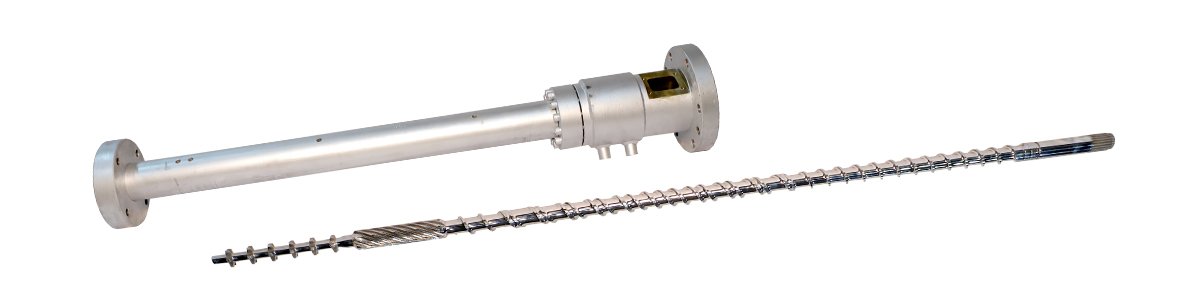
A conventional single-screw extruder screw is divided into three functional zones, and understanding what each one does is the starting point for any specification decision. The feed zone, typically the first 25 to 30 percent of the screw’s working length, has a constant, relatively deep channel depth. Its job is simply to pull solid pellets or powder from the hopper and convey them forward without prematurely compacting or melting the material. The transition zone, sometimes called the compression zone, is where the channel depth gradually decreases. This shrinking volume compresses the solid bed, forces out trapped air, and generates the shear and conductive heat that melts the polymer. The metering zone, the final section before the screw tip, has a shallow and constant channel depth. Its role is to homogenize the melt, stabilize pressure, and deliver a consistent volumetric output to the die. Get the relative lengths of these three zones wrong for your polymer, and you will see incomplete melting, pressure instability, or excessive shear heating no matter how well everything else is specified.
L/D Ratio: Why Length Matters
The length-to-diameter ratio, almost universally abbreviated L/D, describes how many screw diameters long the working flighted length is. A 30:1 L/D screw on a 60 mm extruder has a flighted length of 1,800 mm. This single number has an enormous effect on what the screw can accomplish. Shorter screws, in the 20:1 to 24:1 range, are common on older or simpler lines and tend to rely more heavily on barrel heater conduction to finish melting, which limits output rate and can leave unmelt in the final part. Longer screws, from 28:1 up to 36:1 or more, give the polymer significantly more residence time and shear exposure, which improves melt homogeneity, allows for higher output rates at the same screw speed, and creates room for specialized features such as barrier sections, mixing sections, or vacuum venting for moisture removal. As a rule of thumb, processors running commodity polyolefins at moderate output can succeed with 24:1 to 28:1 designs, while anyone running engineering resins, heavily filled compounds, or recycled content with inconsistent bulk density should be looking at 30:1 or longer.
Compression Ratio and Why It Is Not One-Size-Fits-All
Compression ratio is the ratio between the channel depth in the feed zone and the channel depth in the metering zone. A screw with a 3.5:1 compression ratio compresses the solid bed nearly three and a half times by the time material reaches the metering section. This number must be matched to the polymer’s melting behavior and bulk density. Materials that melt sharply and have a low bulk density, like many forms of polystyrene foam feedstock or low-density powders, typically need a higher compression ratio so that enough mechanical work is generated to melt them efficiently. Materials with a narrow melting range and higher thermal sensitivity, like rigid PVC, need a much lower, gentler compression ratio so the compound does not degrade from excess shear heat before it even reaches the die. Specifying the wrong compression ratio is one of the most common reasons a “generic” screw underperforms when dropped into a specific application.
Flight Geometry, Pitch, and Number of Flights
The helical flight wrapped around the screw root does more than just look distinctive. Its pitch, typically expressed as a ratio relative to the screw diameter, determines how aggressively material is conveyed forward versus how much time it spends being sheared and mixed within each turn. A standard square-pitch screw, where pitch equals diameter, is the default starting point for most general-purpose applications. Reduced-pitch designs increase residence time and mixing intensity, useful for difficult-to-melt or filled materials, but they also reduce maximum output for a given screw speed. Most production extruders use a single flight for the entire length, but some specialized barrier and high-output screws incorporate a second, shallower flight in the transition zone specifically to separate the solid bed from the melt pool more efficiently, accelerating the melting rate without simply increasing shear.
Screw Materials, Hardening, and Coatings
The screw itself is almost always machined from a nitriding-grade alloy steel, then surface-hardened through a gas nitriding process that produces a hard case roughly 0.4 to 0.6 mm deep with a surface hardness in the range of 900 to 1,000 HV (around 65 to 70 HRC). This nitrided layer resists abrasive wear from fillers, pigments, and glass-reinforced compounds. For especially abrasive or corrosive applications, such as compounds loaded with glass fiber, talc, calcium carbonate, or flame retardants containing halogens, processors frequently upgrade to bimetallic flight coatings using tungsten carbide or specialized cobalt-based alloys, or in extreme cases specify a screw machined entirely from a high-performance tool steel. These upgrades cost more upfront, sometimes 30 to 60 percent more than a standard nitrided screw, but for highly abrasive applications they can extend service life from under a year to three years or longer, which makes them dramatically cheaper on a total cost of ownership basis.
Barrel Construction and Liner Technology
The barrel is not simply a steel tube. Production barrels are almost always bimetallic, consisting of a steel or cast-iron outer shell with a centrifugally cast inner liner bonded metallurgically to the bore. The liner material is what actually contacts the polymer and the screw flights, and its selection follows the same abrasion and corrosion logic as screw coatings. Common liner alloys include nickel-chromium-boron alloys for general-purpose abrasion resistance, and more specialized carbide-rich alloys for heavily filled or fiberglass-reinforced compounds. A barrel liner that is mismatched to the compound’s abrasiveness can wear out in a fraction of the screw’s service life, creating an oversized clearance that causes exactly the same backflow and output loss problems described earlier, even though the screw itself might still be in good condition. This is why screw and barrel should always be evaluated and specified together rather than as two independent purchasing decisions.
Heating, Cooling, and Vent Configuration
Beyond the bore itself, a barrel’s external heating and cooling configuration affects how precisely you can control the melt profile along the screw’s length. Cast aluminum heater bands with embedded cooling channels offer faster, more even temperature control than older mica-insulated band heaters, which matters most for temperature-sensitive resins like rigid PVC or for processes running tight melt temperature windows. If your process requires moisture removal during extrusion, such as processing recycled flake or hygroscopic engineering resins without a separate dryer, you will need a barrel machined with a vacuum vent port at the appropriate location along the screw’s transition zone, paired with a two-stage screw design that creates a decompression zone under the vent.
Drive Train and Torque Considerations
Screw and barrel selection does not happen in isolation from the rest of the extruder. A longer L/D ratio, a higher compression ratio, or a barrier design that increases shear all place additional torque demand on the gearbox and drive motor. Before finalizing a specification, confirm with your manufacturer that your existing drive train has adequate torque capacity to run the new screw geometry at your target screw speed without exceeding rated motor amperage, since an otherwise well-specified screw can still underperform, or trip overload protection repeatedly, if the drive system becomes the limiting factor instead of the screw design itself.
Matching Screw and Barrel Design to Your Polymer and Process
Commodity Polyolefins: PE, PP, and General Compounding
Polyethylene and polypropylene are forgiving polymers with a broad processing window, which is exactly why so many processors default to a generic “all-purpose” screw for them and never revisit the decision. A solid starting specification is an L/D ratio between 24:1 and 30:1, a compression ratio in the 2.5:1 to 3.0:1 range, and a standard nitrided screw with a nickel-chromium-boron barrel liner. If your PE or PP line is running a significant percentage of regrind or post-consumer recycled content, bump the compression ratio down slightly and lengthen the feed zone, because bulk density variability in regrind flake makes consistent solids conveying harder to achieve than with virgin pellets.
Rigid and Flexible PVC
PVC compounds are thermally sensitive and begin to degrade if exposed to excess shear heat or extended residence time at high temperature, releasing hydrochloric acid that accelerates corrosion of any unprotected metal surface. PVC extrusion screws use a much lower compression ratio, typically 2.0:1 to 2.5:1, a longer, gentler transition zone, and a shallower flight depth in the metering zone to minimize shear generation. Because PVC is corrosive as well as occasionally abrasive (particularly foam and wood-composite PVC formulations), barrel liners for PVC service should include strong corrosion resistance in addition to wear resistance, and bimetallic screw coatings are standard practice rather than an optional upgrade in most well-run PVC pipe and profile operations.
Engineering Resins: Nylon, Polycarbonate, ABS, and Blends
Engineering thermoplastics often require tighter melt temperature control, lower shear sensitivity tolerances, and in many cases the removal of moisture or volatiles during processing. Screws for nylon and similar hygroscopic resins frequently incorporate a two-stage vented design so that moisture can be pulled off mid-barrel through a vacuum port rather than relying entirely on pre-drying. Polycarbonate and ABS, by contrast, are more concerned with controlling localized shear heating that can cause splay, black specks, or molecular weight degradation, so these screws favor a moderate compression ratio paired with a dedicated mixing section, such as a Maddock or pineapple-style mixer, positioned just ahead of the screw tip to even out the melt without adding excessive shear.
Filled and Reinforced Compounds
Glass fiber, mineral fillers like talc and calcium carbonate, and flame-retardant additive packages dramatically increase the abrasiveness of a compound, sometimes by an order of magnitude compared to unfilled resin. For these applications, barrel liner and screw flight hardness become the dominant purchasing criteria, frequently outweighing geometry considerations. A bimetallic liner with tungsten-carbide content and a fully hardened or carbide-coated screw flight is the standard recommendation once glass fiber loading exceeds roughly 15 to 20 percent by weight. Skipping this upgrade to save on upfront cost is one of the single most common and most expensive mistakes processors make, because clearance wear in heavily filled compounds can occur within months rather than years on a standard nitrided screw.
Single Screw vs. Twin Screw Extrusion
Most profile, pipe, sheet, and film lines run single-screw extruders, which are simpler, less expensive, and well suited to processing relatively homogeneous, pre-compounded resin. Twin-screw extruders, whether co-rotating or counter-rotating, are the standard choice when the process itself requires intensive mixing, such as compounding raw resin with fillers, pigments, and additives from scratch, processing PVC dry blend directly into pipe or profile, or devolatilizing reactive or recycled materials. Co-rotating intermeshing twin screws excel at distributive and dispersive mixing and dominate the compounding industry, while counter-rotating twin screws are the long-standing standard for PVC pipe and profile extrusion because of their strong positive conveying action and gentler shear profile. If your process involves anything beyond melting and shaping a single pre-compounded resin, a twin-screw platform deserves serious evaluation even if it carries a higher capital cost than a comparable single-screw line.
Barrier Screws and High-Output Designs
For processors chasing higher throughput without sacrificing melt quality, barrier screw designs add a secondary flight in the transition zone that physically separates the unmelted solid bed channel from the growing melt pool channel. This forces all solid material to pass through a narrow, controlled barrier gap before joining the melt stream, which dramatically improves melting efficiency and allows output increases of 15 to 30 percent over a comparable conventional screw at the same screw speed and melt quality. Barrier screws cost more to manufacture due to their complex geometry, but for high-volume lines running thousands of hours per year, the throughput gain alone typically pays back the price premium within the first year of operation.
A Step-by-Step Process for Choosing the Right Screw and Barrel
Choosing screw and barrel tooling does not have to be a guessing game if you work through it methodically. Follow these steps in order, and you will arrive at a specification that is matched to your actual process rather than a generic catalog default.
- Document your current process parameters. Before specifying anything new, record your current screw speed, melt temperature, melt pressure, output rate, and any recurring quality defects such as gels, unmelt, or surging. This baseline tells you whether you are solving a wear problem, a capacity problem, or a fundamental design mismatch.
- Characterize your polymer and additive package precisely. Note the resin family, melt flow index, bulk density, moisture sensitivity, filler or fiber content by weight percentage, and the percentage of regrind or recycled content you run. This single step determines roughly 70 percent of your compression ratio, flight depth, and material hardness decisions.
- Define your target output rate and line speed. Work backward from your downstream tooling and cooling capacity to determine the output rate in kilograms or pounds per hour that the screw and barrel actually need to deliver, rather than simply matching whatever the old screw happened to produce.
- Select your L/D ratio and zone proportions based on steps 2 and 3. Difficult-to-melt, filled, or recycled-content materials generally benefit from a longer L/D and a longer transition zone; clean, easy-flowing virgin resin can run efficiently on a shorter, more standard configuration.
- Specify screw and barrel hardness and coating together. Match the abrasion and corrosion resistance of both the screw flight surface and the barrel liner to your most demanding compound, not your easiest one, since most lines run a mix of formulations over time.
- Decide whether you need special features. Vacuum venting, barrier sections, dedicated mixing sections, or a grooved feed throat for higher-output applications should all be evaluated against your specific process needs rather than added by default or skipped to save cost.
- Request a detailed quotation with full geometry documentation. A reputable manufacturer should provide you with a drawing specifying L/D ratio, compression ratio, flight depths by zone, material specification, hardness values, and clearance tolerances, not just a price and a delivery date.
- Plan your installation and break-in procedure. Even a perfectly specified screw and barrel set needs a proper startup procedure, including a gradual ramp to operating temperature and a controlled break-in period at reduced screw speed, to avoid premature wear or seizure.
Common Buying Mistakes (and How to Avoid Them)
Buying on Price Alone
The lowest quoted price for a screw and barrel set is rarely the lowest total cost. A screw priced 20 percent below the competition may be using thinner nitride case depth, a lower-grade barrel liner alloy, or looser manufacturing tolerances that translate directly into shorter service life. When comparing quotes, always ask for the specific hardness values, case depth, and liner alloy designation, and calculate cost per operating hour over the expected service life rather than comparing sticker price alone.
Reusing an Old Specification Without Reviewing It
It is tempting to simply reorder “the same screw we always buy” when a unit wears out. But formulations change over time. A small increase in regrind content, a new flame-retardant package, or a switch to a higher-filler-content compound can quietly turn a previously adequate screw and barrel specification into an undersized one. Review your actual current production mix against the original specification every time you reorder, not just the first time you bought.
Ignoring Barrel Wear When Replacing Only the Screw
Because barrels last longer than screws in most applications, processors often replace a worn screw while leaving an aging, gradually wearing barrel in place. If the barrel bore has worn beyond its design tolerance, even a brand-new screw will show excessive clearance and the backflow problems you were trying to fix will persist. Always measure barrel bore diameter and compare it against original specification before installing a new screw, and budget for periodic barrel liner inspection on the same cycle as screw replacement.
Skipping a Proper Break-In Procedure
A newly installed screw and barrel set has extremely tight running clearances by design. Running it immediately at full speed and full temperature, especially with an abrasive or unmelted feedstock, can cause localized scoring or galling that permanently damages the surface finish. A short, controlled break-in period at reduced speed with a clean, easy-flowing resin protects your investment and is worth the modest loss of production time on day one.
Working With the Right Manufacturing Partner
Once you have worked through polymer characterization, output targets, and geometry decisions, the final variable that determines whether your screw and barrel investment pays off is the quality and expertise of the manufacturer you partner with. A manufacturer that builds custom screw and barrel sets to your exact process specification, rather than pulling from a generic catalog, gives you control over every variable covered in this guide: zone proportions matched to your resin, hardness and coating matched to your additive package, and special features like venting or barrier sections built in from the start rather than retrofitted later.
Look for a supplier that provides precise dimensional documentation, offers material certification for the alloys used in both the screw core and the barrel liner, and stands behind its tooling with a clear wear warranty rather than vague assurances. Many established extrusion processors have found that working with a single trusted manufacturer over multiple orders, rather than shopping purely on price each time, builds a track record that lets the manufacturer fine-tune future specifications based on real wear data from your previous sets. Hi-Tech Screw Barrel Works has built its reputation on exactly this approach, engineering each screw and barrel set to the customer’s actual resin, filler content, and output target rather than selling off a generic shelf, and backing every set with documented material certification and a clear wear warranty. If your current tooling is underperforming or you are specifying a new line, requesting a process review and custom quotation from Hi-Tech Screw Barrel Works is the most reliable way to translate everything in this guide into hardware that performs.
Understanding Wear: How Screws and Barrels Actually Fail
Abrasive Wear
Abrasive wear is the most common failure mode in filled or reinforced compounds. Hard particles such as glass fiber, talc, calcium carbonate, and certain flame retardants act like microscopic sandpaper against both the flight land of the screw and the bore of the barrel every time the screw rotates. Over millions of rotations, this gradually erodes the hardened surface layer, widening the clearance between flight and bore. Because the wear is progressive and largely invisible from outside the barrel, it is usually only caught through declining output trends, melt pressure drift, or a scheduled bore-gauging inspection.
Corrosive Wear
Corrosive wear occurs when a polymer or additive package releases acidic or otherwise reactive byproducts during processing. PVC releasing hydrochloric acid is the textbook example, but flame retardants containing bromine or chlorine, as well as some grades of nylon, can also generate corrosive conditions at processing temperature. Corrosion attacks unprotected steel chemically rather than mechanically, pitting the surface and roughening it in ways that accelerate subsequent abrasive wear even if the compound itself is not highly abrasive.
Adhesive Wear and Galling
Adhesive wear, often called galling, happens when metal-to-metal contact occurs between the screw flight and the barrel bore, typically due to insufficient clearance, screw deflection under load, or running without adequate melt cushion during startup. This is the failure mode a proper break-in procedure is specifically designed to prevent, because galling can score both surfaces badly enough to require immediate replacement rather than gradual wear-based retirement.
Fatigue and Mechanical Failure
Less common but more catastrophic than wear-based failure, fatigue cracking can occur at stress concentration points such as the screw root near the thrust bearing connection, particularly on screws that have been repeatedly subjected to torque overload from frozen melt, tramp metal contamination, or operating well beyond rated screw speed. Regular torque monitoring and metal detection upstream of the hopper are the most effective preventive measures against this failure mode.
Screw and Barrel Specification Checklist
Use this checklist when reviewing a quotation or specification drawing from a manufacturer, to make sure every variable covered in this guide has actually been addressed rather than left at a generic default.
• Confirm the L/D ratio matches your polymer’s melting behavior and your output target, not just the extruder’s existing barrel length
• Confirm feed, transition, and metering zone lengths are stated individually, not just the overall L/D
• Confirm compression ratio is appropriate for your resin family and filler content
• Confirm flight depth in the metering zone supports your target output rate at a reasonable screw speed
• Confirm screw core material, nitriding case depth, and surface hardness values are documented
• Confirm whether a bimetallic or carbide coating is included, and on what basis it was selected
• Confirm barrel liner alloy designation and its suitability for your compound’s abrasiveness and corrosivity
• Confirm radial clearance between flight tip and barrel bore is specified in writing
• Confirm whether venting, barrier sections, or mixing sections are included and why
• Confirm heater and cooling configuration matches your required melt temperature control precision
• Confirm a wear warranty or performance guarantee is included in the quotation
• Confirm lead time, installation support, and break-in guidance are part of the purchase
Cost, ROI, and Total Cost of Ownership
Why Upfront Price Is the Wrong Metric
Two screw and barrel sets can look identical on a quotation summary while differing enormously in actual value. A unit specified with a thin nitride case and a standard liner alloy might cost 15 to 25 percent less upfront than a fully optimized set with a deeper case and an upgraded liner, but if it wears out in 14 months instead of lasting 36 months, the cheaper option actually costs more per operating hour once you account for replacement labor, line downtime during changeover, and the gradual output and scrap losses that occur as the unit wears before final failure.
Building a Simple ROI Comparison
A useful way to compare two competing quotations is to estimate cost per ton of material processed over the expected service life of each option, rather than comparing purchase price alone. Start with the purchase price, add an estimate of installation and downtime cost, then divide by the expected output in tons over the unit’s projected service life. In nearly every documented case where processors have compared a properly specified, upgraded screw and barrel set against a generic low-cost replacement on this basis, the upgraded option wins decisively, often by a factor of two or more, once wear-related output losses in the final months of the cheaper unit’s life are factored in.
Hidden Costs of Under-Specification
Beyond the direct cost of more frequent replacement, an under-specified screw and barrel set carries hidden costs that rarely show up on a maintenance budget line item: increased scrap and regrind generation from inconsistent melt quality, more frequent unplanned stops for purging and troubleshooting, higher energy consumption per kilogram of output as a worn screw works harder to convey the same volume of material, and in serious cases, customer complaints or rejected shipments caused by visual or dimensional defects traced back to melt instability.
A Quick Glossary of Key Extrusion Screw and Barrel Terms
• Backflow (Screw Slip): Melted polymer flowing backward over a worn flight tip instead of being conveyed forward, reducing effective output.
• Bimetallic Barrel: A barrel with a centrifugally cast wear-resistant liner metallurgically bonded inside a steel or cast-iron outer shell.
• Compression Ratio: The ratio of channel depth in the feed zone to channel depth in the metering zone.
• Flighted Length: The portion of the screw that has helical flights, used to calculate the L/D ratio.
• Grooved Feed Throat: A barrel feed section with longitudinal grooves that improve solids conveying and allow higher output, common on high-output PE and PP lines.
• L/D Ratio: Flighted length divided by screw diameter, describing how long the screw is relative to its diameter.
• Melt Pool: The pocket of fully melted polymer that grows within the screw channel as the solid bed shrinks through the transition zone.
• Metering Zone: The final, constant-depth section of the screw responsible for homogenizing and stabilizing melt delivery to the die.
• Nitriding: A heat-treatment process that diffuses nitrogen into a steel surface to create a hard, wear-resistant case layer.
• Radial Clearance: The gap between the outer diameter of the screw flight and the inner bore of the barrel.
• Solid Bed: The unmelted core of polymer pellets or flake that travels through the feed and transition zones before fully melting.
• Vented Barrel: A barrel machined with a port that allows moisture or volatiles to be removed under vacuum during extrusion.
Maintenance, Inspection, and Extending Service Life
Routine Visual and Operational Checks
Even the best-specified screw and barrel set needs ongoing attention to reach its full service life potential. Operators should be trained to log screw speed, melt temperature, melt pressure, and motor amperage or torque at the start of every shift, and to flag any gradual drift in these numbers rather than waiting for an obvious failure. A slow upward creep in screw speed needed to maintain the same output, paired with a slow downward drift in melt pressure, is one of the earliest and most reliable indicators of developing flight or bore wear, often visible weeks or months before output drops enough to be obvious on the line.
Scheduled Bore Gauging
Barrel bore diameter should be measured at multiple points along its length on a regular schedule, typically every six to twelve months for moderately abrasive compounds and as often as every three months for heavily filled or glass-reinforced applications. Bore gauging uses a precision internal micrometer or a dedicated bore gauge to detect out-of-round or oversized conditions before they become severe enough to cause visible quality problems. Tracking these measurements over time creates a wear-rate trend line that lets a plant predict replacement timing months in advance, turning an unplanned failure into a scheduled maintenance event that can be planned around production demand.
Screw Inspection and Flight Measurement
When a screw is pulled for inspection or cleaning, flight outer diameter should be measured at several points along the length, particularly in the metering zone where wear has the greatest effect on output. Comparing these measurements against the original manufacturing specification, rather than simply eyeballing the surface for visible damage, is the only reliable way to catch gradual wear before it becomes a production problem. Many processors also benefit from photographing the flight surface at each inspection to build a visual record that makes subtle changes easier to spot over successive inspections.
Proper Purging and Shutdown Procedures
Improper purging between resin changes or at shutdown is a frequent, preventable cause of accelerated wear and contamination-related defects. Using an appropriate purging compound, run at the correct temperature and for a sufficient duration, clears degraded or cross-contaminated material from the screw channel and barrel bore. Skipping or rushing this step allows carbonized or cross-contaminated material to build up in low-flow areas of the screw, which can later break loose and cause both quality defects and localized abrasive damage as the fragments pass through the metering zone and die.
Storage and Handling Between Uses
Screws that are removed from service for inspection, cleaning, or rotation between lines should be stored horizontally on padded supports, never resting directly on the hardened flight surface, and coated with a light rust-preventive oil if they will be out of the barrel for an extended period. Improper storage and handling can introduce surface damage or corrosion that has nothing to do with the screw’s actual processing performance but still shortens its effective service life.
Industry Trends Shaping Screw and Barrel Selection
Rising Recycled Content Requirements
Regulatory and brand-owner pressure to increase post-consumer recycled content in packaging and durable goods is changing what processors ask of their screw and barrel tooling. Recycled flake and regrind typically have lower and more variable bulk density than virgin pellets, contain higher levels of contamination and moisture, and can include unexpected hard particles such as label adhesive residue, metal fragments, or incompatible polymer fractions. Screw and barrel sets specified for high-recycled-content processing increasingly favor longer feed zones, more aggressive solids conveying geometry such as grooved feed throats, and barrel liners selected for both abrasion and corrosion resistance even when processing nominally non-corrosive base resins, because contamination byproducts in recycled streams behave unpredictably.
Energy Efficiency and Throughput-Per-Kilowatt Targets
As energy costs and sustainability reporting requirements both increase, more processors are evaluating screw and barrel performance not just on raw output but on energy consumed per kilogram of product. Barrier screw designs and optimized compression ratios that achieve full melting with less unnecessary shear heating directly reduce specific energy consumption, and several processors who have upgraded from older, generic screw geometries report measurable reductions in barrel heater duty cycle alongside their throughput gains, since a more efficient melting profile relies less on resistive heating to finish the job.
Condition Monitoring and Predictive Maintenance
Sensor-equipped barrels with embedded melt pressure and temperature transducers at multiple points along the barrel length, paired with vibration and torque monitoring on the drive train, are increasingly available even on mid-sized extrusion lines, not just the largest compounding operations. This data allows plants to move from calendar-based screw and barrel replacement toward genuine condition-based replacement, scheduling downtime around actual measured wear trends rather than a generic interval that may be too conservative or, just as often, too aggressive for the specific compound being run.
Real-World Scenarios: Matching Tooling to Application
Scenario One: A Pipe Extruder Running High-Filler PVC Compound
A mid-sized PVC pipe manufacturer was experiencing a recurring pattern of declining output and increasing scrap roughly every fourteen months, traced eventually to barrel bore wear well beyond original tolerance. Investigation revealed the barrel liner alloy had been specified for general PVC service without accounting for a calcium carbonate filler package the plant had added to reduce material cost several years earlier. Re-specifying the replacement barrel with a liner alloy rated for the actual current filler loading, alongside a matching bimetallic screw upgrade, extended subsequent service life to over three years while also improving output consistency batch to batch.
Scenario Two: A Film Line Increasing Recycled Content
A flexible packaging film producer aiming to meet a customer’s recycled-content packaging commitment found that simply increasing regrind percentage on their existing screw caused surging and gel formation that had not been present with virgin resin alone. Working with their tooling supplier to lengthen the feed zone and add a grooved feed section addressed the inconsistent solids conveying caused by the lower and more variable bulk density of the regrind blend, allowing the higher recycled content target to be met without sacrificing film quality.
Scenario Three: A Compounder Scaling Up Glass-Filled Engineering Resin
A custom compounder bringing a new 30 percent glass-fiber-filled nylon formulation into production initially ran it on a twin-screw configuration optimized for unfilled and lightly filled compounds. Excessive fiber attrition and rapid screw element wear prompted a redesign using wear-resistant element materials in the high-shear mixing zones specifically, while leaving gentler conveying elements unchanged elsewhere in the screw configuration, balancing fiber length retention against acceptable wear rates and component cost.
Troubleshooting Guide: Symptoms and Likely Causes
Even with a well-specified screw and barrel set, production problems still occur, and knowing how to read the symptoms quickly saves hours of guesswork on the line. The table below summarizes the most common symptoms processors report and the screw and barrel causes most likely to be responsible, alongside the diagnostic step that confirms or rules out each one.
Surging or pulsing output is most often caused by inconsistent solids conveying in the feed zone, frequently the result of a worn or undersized feed section, inconsistent pellet bulk density, or moisture in the feedstock. The diagnostic step is to check hopper feed consistency and bulk density variability before assuming the screw itself is at fault.
Declining output at constant screw speed, especially when paired with falling melt pressure, points strongly toward flight or bore wear increasing the radial clearance and allowing backflow. The diagnostic step is to gauge the barrel bore and measure screw flight diameter against original specification.
Unmelted particles or gels in the final product usually indicate insufficient residence time or shear in the transition zone, which can result from an L/D ratio or compression ratio that is too low for the resin, or from a damaged mixing section. The diagnostic step is to review the original screw design against current resin and filler content, since formulation changes over time are a frequent root cause.
Excessive melt temperature relative to setpoint, even with heaters functioning normally, often signals over-shearing from a compression ratio or screw speed that is too aggressive for the material. The diagnostic step is to compare actual melt temperature against the resin supplier’s recommended processing window and consider whether screw speed has crept upward to compensate for wear elsewhere.
Rising melt pressure with falling or flat output typically points to a downstream restriction such as a fouled breaker plate, contaminated screen pack, or partially blocked die, rather than a screw or barrel issue, and should be investigated there first before any tooling is pulled for inspection.
Inconsistent color or streaking in the final product can result from inadequate mixing in the metering zone, degraded material trapped in low-flow dead spots within a worn or poorly designed screw channel, or cross-contamination from an inadequate purge between resin changes, and the diagnostic step is to inspect the screw surface directly for buildup or degraded residue once it is pulled from the barrel.
How to Evaluate a Manufacturer Before You Buy
Engineering Support and Process Review
The strongest indicator of a manufacturer worth partnering with is whether they ask detailed questions about your resin, filler content, output targets, and current performance problems before quoting a price, rather than simply asking for your old screw’s dimensions to copy. A manufacturer willing to conduct a genuine process review, including reviewing your current wear patterns and production data, is far more likely to deliver a specification that actually solves your problem rather than reproducing it.
Manufacturing Quality and Documentation
Ask any prospective supplier for documentation of their nitriding case depth and hardness testing procedures, their barrel liner alloy certifications, and their dimensional tolerance standards. Reputable manufacturers will provide this without hesitation; vague or evasive answers to these specific questions are a reliable warning sign regardless of how competitive the quoted price appears.
Lead Time, Support, and Warranty
Beyond the hardware itself, evaluate how a manufacturer supports you after the sale. Clear lead time commitments, availability of emergency or expedited service for unplanned failures, willingness to provide installation and break-in guidance, and a wear warranty that is specific and measurable rather than vaguely worded all indicate a manufacturer that expects its tooling to perform and stands behind it accordingly.
Additional Resources
For readers who want to continue building their extrusion process knowledge, related resources on screw design fundamentals, polymer processing temperature guidelines, and extruder maintenance schedules can be found in your manufacturer’s resource library and product catalog pages. Authoritative third-party references such as the Society of Plastics Engineers and SPI: The Plastics Industry Association also publish technical papers and processing guidelines covering screw and barrel design, melt rheology, and extrusion troubleshooting that complement the practical guidance in this article. When researching further, look specifically for content addressing your resin family and filler content, since generic extrusion theory only goes so far once your specific compound’s behavior is taken into account.
Frequently Asked Questions
Service life depends heavily on the abrasiveness of your compound, but as a general benchmark, unfilled commodity resins can run 3 to 5 years before clearance wear becomes significant, while heavily filled or glass-reinforced compounds may require replacement or rebuild within 12 to 18 months.
New tooling typically starts with a radial clearance of around 0.1 to 0.15 mm per side depending on screw diameter. Most processors consider a clearance of 0.4 to 0.5 mm or greater to be a strong signal that output and quality losses are occurring and replacement should be scheduled.
Increasing screw speed beyond the design intent of your current geometry often increases shear heating and reduces melt quality faster than it increases usable output. A barrier screw or properly re-specified geometry is usually a more effective path to higher throughput.
Not necessarily. A vented, two-stage barrel adds cost and complexity, and is most valuable when pre-drying is inconsistent, when you run a significant percentage of recycled content, or when your resin is highly hygroscopic. If your drying process is reliable, a standard non-vented barrel is often the more cost-effective choice.
Compare your actual melt pressure and output rate against the original commissioning data for your line. A worn screw typically shows declining output at the same screw speed alongside falling melt pressure, while a restricted or fouled die tends to show rising melt pressure with stable or declining output.
Rebuilding, which typically involves re-machining the barrel bore slightly oversized and fitting a new screw with a matching oversized flight diameter, can be cost-effective once or twice over a barrel’s life. Beyond that, diminishing wall thickness and liner integrity usually make full replacement the more reliable and economical choice.
Pricing varies widely by diameter and L/D ratio, but a bimetallic upgrade with carbide-enhanced barrel liner typically adds 25 to 50 percent to the upfront cost of a standard nitrided set, an investment that is almost always recovered through extended service life in moderately to heavily abrasive applications.
Yes, within limits. A well-specified general-purpose set can often handle several compatible resins in the same family, such as different grades of PE or PP, but switching between fundamentally different polymer types, such as from PE to PVC, usually requires a dedicated, separately specified screw and barrel set to avoid compromising performance on either material.
Conclusion
Selecting the right screw and barrel for your extrusion process comes down to three connected decisions: matching the geometry, including L/D ratio, compression ratio, and zone proportions, to your specific polymer and output target; matching the screw flight and barrel liner hardness to the abrasiveness and corrosivity of your full compound mix, not just your easiest formulation; and choosing a manufacturing partner who documents and stands behind the specification rather than selling off a generic shelf. These decisions are not one-time events either. As your formulations evolve, your recycled content targets increase, or your output requirements grow, your screw and barrel specification should be revisited rather than assumed to still be correct simply because it was correct when it was first ordered.
Get these three decisions right, and your screw and barrel set will deliver consistent output, stable melt quality, and a service life measured in years rather than months, while also reducing the energy, scrap, and labor costs that come with chasing wear-related problems on an ongoing basis. If your current line is showing signs of wear, surging, or declining throughput, the most cost-effective next step is a full process review and custom screw and barrel quotation from Hi-Tech Screw Barrel Works, so you can replace guesswork with a specification built around your actual production data rather than a generic catalog default.
Leave A Comment