
- Home
- Conical Screw Barrel
- Conical Screw
Conical Screw
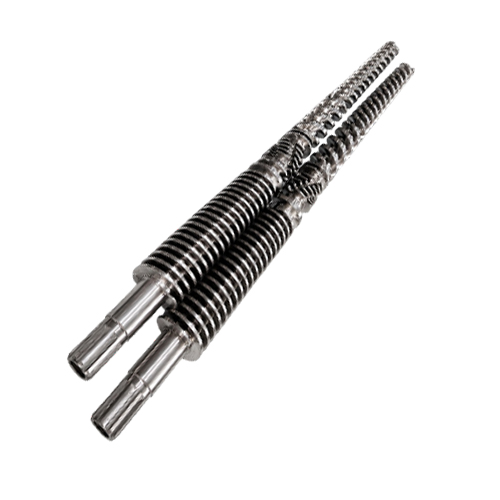
A conical screw is a precision-machined extrusion component that serves as the rotating core of a twin-screw extruder. Unlike a parallel screw where the diameter stays uniform from feed to discharge, a conical screw features a tapered profile — larger at the feed end and progressively narrower toward the discharge end. This geometry defines the technology and makes it exceptionally well-suited for processing thermally sensitive materials such as rigid PVC, plasticized PVC, CPVC, and wood-plastic composites.
Conical Screw
Price of Conical Screw
| Models |
Minimum Price (In Rs) |
Maximum Price (In Rs) |
|---|---|---|
|
65/132, 55/120, 51/105, 80/156 |
Rs. 1,40,000 |
Rs. 2,90,000 |
In a twin-screw extruder, two matched screws — one left-hand helix and one right-hand helix — work in close intermeshing contact within a precisely bored conical barrel. The converging taper generates a continuous, progressive compression of the polymer from feed to discharge. This positive-displacement conveying action delivers consistent output pressure and melt homogeneity that is difficult to replicate with any other screw design. The component simultaneously handles feeding, compressing, melting, mixing, homogenizing, and metering — all in one continuous, efficient process.
At Hi-Tech Screw Barrel Works, each conical screw is manufactured using high-performance nitriding steels and high-speed tool steels, processed through advanced CNC machining centres and dedicated surface treatment facilities. The result is a component built to deliver superior output consistency and extended operational life in even the most demanding production environments — engineered for precision, built for power, and designed to last.
Hi-Tech Screw Barrel Works supplies precision conical screws to PVC pipe plants, profile extrusion units, compounding facilities, cable manufacturers, and extruder OEMs — backed by decades of specialised engineering expertise and an ISO 9001:2015 certified manufacturing process.
Technical Specifications
| Specification | Technical Details |
|---|---|
|
Models |
65/132, 55/120, 51/105, 80/156 Etc. |
|
Material |
Bimetallic Type Or Nitrided Type |
|
Surface Treatment |
Gas Nitriding, Hard Chrome Plating |
|
Surface Hardness |
65–68 HRC (500–550°C) |
|
Nitriding Depth |
0.5 mm to 0.6 mm |
|
Wear Protection |
Bimetallic Coating & Tungsten Carbide Coating On Screw |
|
Suitable Materials |
PVC, CPVC |
|
Suitable Industries |
PVC/CPVC Pipe Manufacturing, PVC Profile Manufacturing Etc. |
|
Suitable Machineries |
PVC/ CPVC Pipe Extrusion, PVC Profile Extrusion Etc. |
|
Condition |
New |
|
Stock |
As Per Order |
Salient Features of Conical Screw
Precision Conical Geometry
The taper from a large feed-end diameter to a smaller discharge-end diameter creates natural volumetric compression, ensuring progressive and gentle plasticization ideal for shear-sensitive thermoplastics like rigid PVC. This inherent compression eliminates the need for complex flight geometry modifications.
Premium Nitriding Steel Base Material
Every screw is manufactured from 38CrMoAlA or bi-metallic alloys — selected for their superior nitriding response, mechanical toughness, and long-term dimensional stability under the cyclic stress conditions of continuous extrusion service.
Advanced Gas and Ion Nitriding
Screw surfaces are nitrided to HRC 65-68 surface hardness at 0.5-0.6 mm depth — delivering outstanding wear and corrosion resistance with minimal dimensional distortion of the precision-machined flight geometry. Both gas nitriding and ion plasma nitriding are available depending on application requirements.
CNC Precision Machined Flights
All flight profiles — helix angle, flight depth, root diameter, and outer diameter — are CNC machined to micron-level tolerances, ensuring correct inter-meshing of the matched pair and accurate clearance within the barrel bore throughout the screw length.
Optimized Compression Ratio
Compression ratios are carefully calculated to match the specific material and processing requirements of each application, ensuring efficient melt pressure build-up, uniform thermal distribution, and consistent melt homogeneity across the entire operating throughput range.
Tungsten Carbide Flight Tip Hardfacing — Optional
For highly abrasive compound processing, HVOF-applied tungsten carbide hardfacing on flight tips provides dramatically enhanced wear life — typically extending the service interval by a factor of two to three times compared to standard nitrided flight tips.
Polished Root Surface Finish
The screw root and flight flanks are ground and polished to a smooth, low-friction finish, minimising material adhesion, preventing localised degradation at stagnation points, and enabling faster, cleaner colour changeovers and purging between production runs.
Matched Pair Supply
Both screws in every set are manufactured, dimensionally verified, and cross-checked as a matched pair — ensuring correct helix timing, balanced flight clearances, and uniform melt quality from both channels from installation through to the end of service life.
Applications

Working Mechanism of the Conical Screw
Feed Zone
Raw PVC compound or granules are introduced at the large-diameter feed opening. The high free volume at the feed end ensures consistent material intake and prevents bridging or starve-feeding, maintaining a steady, uniform supply of material into the processing zone.
Compression Zone
As material advances, the tapering screw geometry progressively reduces the inter-screw free volume. This compression generates frictional and conductive heat that initiates melting, building melt pressure gently and continuously without the mechanical shock associated with abrupt compression transitions.
Melting Zone
The combination of barrel heater energy and controlled shear from the counter-rotating screws fully plasticizes the material. The intermeshing, counter-rotating action creates a self-wiping effect that prevents material stagnation at the screw root and barrel wall, ensuring uniform thermal treatment and eliminating localised degradation.
Mixing and Homogenization Zone
The intermeshing screw flights promote both distributive and dispersive mixing of all additives — stabilizers, lubricants, pigments, and processing aids — into the polymer melt. The positive conveying action ensures that all material passes through the mixing zone, eliminating unmixed pockets in the final extrudate.
Why Choose Hi-Tech Screw Barrel Works
Engineering Expertise You Can Rely On
With over three decades of specialised experience in screw and barrel manufacturing, our engineering team has developed a deep understanding of the critical relationship between screw geometry, material properties, and processing performance. Every conical screw is designed and manufactured to the specific material and production output requirements of the customer — not a generic, off-the-shelf component.
Advanced In-House Manufacturing
Our facility operates a vertically integrated manufacturing chain encompassing raw material inspection, CNC rough turning and precision finish machining, cylindrical grinding, dedicated nitriding furnaces, and calibrated CMM inspection — all under one roof. This end-to-end capability gives us complete control over quality, lead times, and manufacturing consistency at every stage, with no outsourcing of critical processes.
ISO 9001:2015 Certified Quality System
Every screw supplied is backed by an ISO 9001:2015 certified quality management system. Critical dimensions are verified on calibrated CMM equipment, surface hardness is Rockwell tested post-nitriding, and each matched pair is dispatched with a complete dimensional inspection certificate and material test report — giving customers full traceability from raw material to finished component.
OEM and Custom Manufacturing Capability
Hi-Tech Screw Barrel Works is a preferred OEM manufacturing partner for extruder builders and plastic processors requiring screws to exact engineering drawings, specific material grades, and proprietary dimensional specifications. We work from customer drawings, reverse-engineered worn samples, or extruder model references — delivering parts that match or exceed original equipment standards.
Refurbishment and After-Sales Support
Beyond new manufacture, we offer comprehensive screw refurbishment — including tungsten carbide HVOF re-coating of worn flight tips, hard chrome re-plating, cylindrical re-grinding, and re-nitriding — restoring worn screws to near-original performance at a fraction of replacement cost. Our technical team provides ongoing support for maintenance scheduling, processing troubleshooting, and application-specific specification guidance.
Manufacturer, Exporter and Supplier — Ahmedabad, Gujarat, India
Hi-Tech Screw Barrel Works is a leading manufacturer, exporter, and supplier of precision conical screws based in Ahmedabad, Gujarat, India. Our strategic location in Gujarat — India’s foremost engineering manufacturing hub — gives us access to a robust supply chain, a highly skilled engineering workforce, and excellent port connectivity for serving customers across India, the Middle East, Africa, Southeast Asia, and Europe. We supply to plastic pipe manufacturers, profile extrusion units, compounding plants, and machinery OEMs both domestically and internationally, with competitive export pricing, reliable logistics, and on-time delivery backed by our certified manufacturing process.
FAQs
What is a conical screw and how does it differ from a parallel screw?
A conical screw is a precision extrusion component with a tapered geometry — large at the feed end and progressively narrowing toward the discharge end — as opposed to a parallel screw which maintains a constant diameter along its full length. This taper creates a natural, built-in compression effect: as material moves from the large feed zone toward the smaller discharge zone, the inter-screw free volume reduces continuously, generating progressive melt pressure without requiring complex flight geometry modifications. The result is a gentler, more controlled shear environment ideal for thermally sensitive materials such as rigid PVC. Parallel screws generate compression through changes in flight depth or pitch and are better suited to high-throughput compounding applications where intensive mixing is the priority. At Hi-Tech Screw Barrel Works, conical screws are engineered with precisely calculated taper angles and compression ratios matched to the specific material and machine requirements of each customer, ensuring optimal processing performance from the very first production run.
What materials are used to manufacture conical screws?
The base materials selected for conical screw manufacture are chosen with meticulous care, prioritising superior nitriding response, mechanical toughness, and long-term dimensional stability. The primary material is 38CrMoAlA — a chromium-molybdenum-aluminium alloy steel specifically developed for nitriding applications, offering outstanding surface hardness after heat treatment while maintaining a tough, ductile core. For high-performance applications requiring greater base hardness, bi-metallic alloys is selected. All incoming raw material is verified against material test certificates and independently checked for chemical composition and hardness before entering the production floor. After CNC rough machining and precision finish grinding, screws undergo gas or ion nitriding to achieve a controlled surface hardness of HRC 60–65 at a case depth of 0.4–0.6 mm, with a tough HRC 28–35 core beneath — the ideal combination of wear resistance and fracture toughness for demanding extrusion service.
Which industries use conical screws?
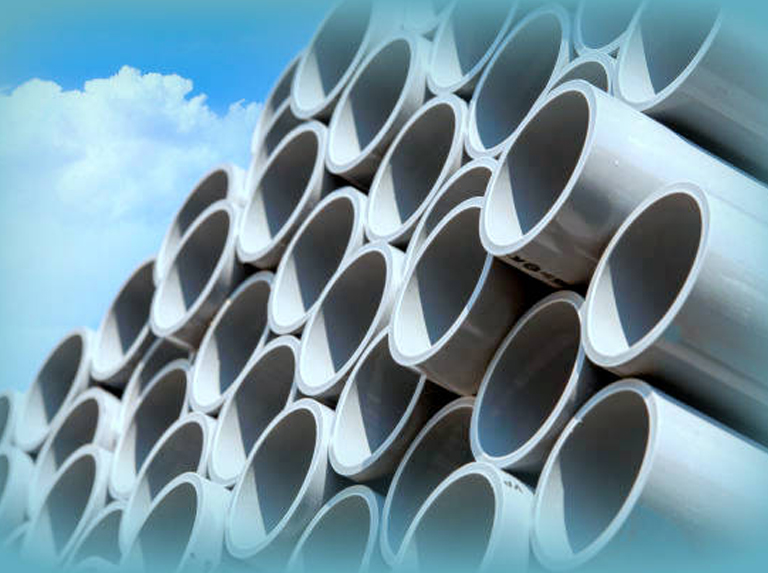
This extrusion component serves a broad range of plastic processing industries. The largest single application is PVC pipe extrusion — including uPVC pressure pipes, SWR drainage pipes, electrical conduit pipes, and borewell casings. PVC profile extrusion for doors, windows, roller shutters, and architectural trims is another major sector. Precision screws also power the production of foam boards, and wood-plastic composite boards for furniture, signage, and construction applications. Cable and wire sheathing, masterbatch manufacturing, CPVC pipe extrusion, and automotive component production all rely on this technology. Hi-Tech Screw Barrel Works caters to each of these sectors with application-specific screw specifications, backed by technical consultation at every stage of the ordering process.
What standard sizes of conical screws are available?
Standard sizes cover the most popular twin-screw extruder models in use across India and internationally. Available sizes include 65/132, 80/156, and 55/120, 51/105 — where the first number is the feed-end screw diameter and the second is the corresponding barrel bore diameter in millimetres. These cover output capacities from approximately 80 kg/hour to over 600 kg/hour for rigid PVC applications. Standard L/D ratios of 18:1 and 20:1 are held in production; 16:1 and 22:1 are also regularly manufactured. Beyond standard sizes, Hi-Tech Screw Barrel Works routinely produces non-standard and fully custom screws based on customer engineering drawings or reverse-engineered from worn samples. Customers are encouraged to provide the extruder make and model, dimensional drawings, or a worn screw sample so that all critical dimensions can be confirmed before production begins.
How is wear resistance ensured in a conical screw?
Wear resistance is achieved through a combination of premium base material selection, advanced CNC machining, and dedicated surface engineering. Following precision machining to final flight and root dimensions, each screw undergoes gas nitriding or ion plasma nitriding. The nitriding process diffuses nitrogen into the steel surface, forming an ultra-hard compound layer at HRC 60–65 and a hardened diffusion zone extending to 0.4–0.6 mm depth — providing exceptional resistance to abrasive wear from filled or mineral-loaded compounds. The tough, ductile core beneath absorbs cyclic mechanical stresses without risk of brittle fracture. For customers processing highly abrasive materials such as mineral-filled PVC, WPC, or recycled PVC, optional tungsten carbide HVOF thermal spray hardfacing on flight tips provides a significant further increase in abrasion resistance and extends the interval between clearance re-checks and refurbishment events.
What is the typical service life of a conical screw?
Service life depends on several interacting factors including the abrasiveness of the compound being processed, the running speed and throughput rate, processing temperatures, purging discipline, and the quality of routine maintenance. For standard rigid PVC pipe extrusion with virgin compound and moderate calcium carbonate filler content, a service life of 8,000 to 15,000 operating hours is typically achievable with a standard nitrided screw. In more abrasive applications such as highly filled PVC or WPC with wood flour, service life may range from 6000 to 7000 hours. With optional tungsten carbide HVOF flight tip coatings, service life in abrasive applications can be extended by a factor of two to three times compared to standard nitrided screws. Our technical team is always available to advise on expected service life and recommended inspection intervals specific to your production conditions.
What is the significance of the L/D ratio in a conical screw?
The L/D ratio — the ratio of active screw length to reference screw diameter — is one of the most important design parameters governing processing performance. In conical screws, the L/D ratio is typically calculated using the arithmetic mean of the feed-end and discharge-end diameters. A higher L/D ratio such as 22:1 provides a longer processing path and greater residence time, enabling more thorough plasticization, better homogenization of additives, and more complete devolatilization of moisture. A lower ratio such as 16:1 results in a shorter, more compact screw suited to materials that plasticize readily and where minimising thermal exposure is the priority. For most rigid PVC pipe and profile applications, L/D ratios of 18:1 and 20:1 represent the optimum balance. Hi-Tech Screw Barrel Works manufactures across the full range of standard L/D ratios and can produce custom ratios for specific machine configurations.
Can conical screws be manufactured for obsolete or non-standard extruder models?
Yes — custom and non-standard manufacturing is a core strength of our operation. Replacement screws are regularly produced for obsolete or discontinued extruder models where OEM spares are no longer available. The engineering team is experienced in reverse engineering from worn or damaged screw samples — using precision CMM measurement and CAD reconstruction to create accurate manufacturing drawings from which exact replacements are produced. Custom specifications including non-standard taper angles, unusual keyway configurations, special drive spline geometry, and modified flight profiles are all within regular capability. Customers are encouraged to send worn screw samples along with the extruder make, model, and any available documentation. A manufacturing drawing is prepared for customer approval before production commences, ensuring complete dimensional accuracy of every replacement component.
What quality checks are performed before dispatch?
Quality assurance is a multi-stage process integrated at every step of manufacture, not a single end-of-line inspection. The process begins with incoming raw material verification — chemical composition certificates and hardness values are checked against specifications before any steel enters production. During CNC machining, all critical dimensions are verified at multiple stages using calibrated CMM equipment and precision instruments. After nitriding, each screw is Rockwell hardness tested at multiple points along the flight surface to confirm the specified HRC 65-68, and test coupons are metallographically sectioned to verify the 0.5 – 0.6 mm nitriding depth. Final inspection includes full dimensional verification of all critical parameters, surface finish assessment, and visual inspection for surface defects. Each matched pair is dispatched with a complete dimensional inspection report and quality certificate, providing full manufacturing traceability for every component supplied.
Does Hi-Tech Screw Barrel Works offer conical screw refurbishment?
Yes. A comprehensive refurbishment service is offered, extending the useful operational life of worn screws at substantially lower cost than full replacement. The process begins with a thorough dimensional assessment — measuring flight tip OD at multiple points, checking for flight damage and taper distortion, and evaluating the remaining nitrided case depth. For screws with moderate flight tip wear, tungsten carbide HVOF thermal spray is applied to build up the worn flight tip diameter, which is then precision ground to the correct OD tolerance. Alternatively, hard chrome plating can restore dimensions in less severely worn screws. Following dimensional restoration, screws are re-nitrided where the hardness layer has been compromised and all flights are re-ground to final profile. The refurbished screw undergoes the same comprehensive inspection as a new component before dispatch. Properly executed refurbishment typically restores a worn screw to 90–95% of its original specification at approximately 40–60% of the cost of a new replacement.
What causes premature wear in a conical screw?
Premature wear is most commonly caused by a combination of operational, material, and maintenance-related factors. The single most damaging practice is cold-starting the extruder — rotating screws against solidified, un-plasticised PVC from a previous production run, which causes severe scoring or cracking of flight tips. Processing highly abrasive compounds without the appropriate upgraded screw specification also accelerates wear significantly. Chemical attack from hydrochloric acid generated by thermally degraded PVC — caused by insufficient stabilizer levels or excessive processing temperatures — aggressively corrodes the nitrided surface and barrel bore. Foreign contamination such as metal fragments or hard agglomerates entering with the raw material can cause sudden, catastrophic flight damage. Correct warm-up protocols, appropriate screw specifications for the compound being processed, maintaining correct stabilizer levels and temperatures, and fitting magnetic separators in the feed system are all recommended preventive measures.
What role does nitriding play in screw performance?
Nitriding is the most critical surface engineering process applied to each screw and is the primary source of outstanding wear and corrosion resistance. The process — either gas nitriding in a controlled ammonia atmosphere at 480–530°C or ion plasma nitriding in a low-pressure nitrogen-hydrogen plasma — causes nitrogen atoms to diffuse into the steel surface and react with alloying elements to form a complex multi-phase compound layer. This layer consists primarily of epsilon and gamma-prime iron nitride phases with extremely high hardness, providing exceptional resistance to abrasive wear from filled polymers and to corrosion from hydrochloric acid generated during PVC processing. At Hi-Tech Screw Barrel Works, all nitriding parameters are precisely controlled and verified through test coupon metallographic analysis for every batch, ensuring the correct nitriding depth of 0.4–0.6 mm is consistently achieved before any batch is approved for dispatch.
What maintenance practices are recommended for conical screws?
Proper maintenance is the most important factor — beyond the quality of the screw itself — in maximising service life and consistent production quality. Always warm up the extruder to the correct processing temperature for at least 20–30 minutes before starting the screws, ensuring all residual PVC in the barrel is fully plasticised before applying torque. At the end of each production run, purge the extruder thoroughly with a compatible natural flushing compound to remove all PVC residue, preventing carbonisation and corrosive acid build-up during shutdown periods. Conduct quarterly dimensional inspections measuring flight tip OD at multiple points along the taper and comparing against baseline dimensions to track wear rate and plan timely refurbishment. Maintain a detailed maintenance log tracking all measurements, operational anomalies, and corrective actions — this enables accurate prediction of remaining service life and avoids unexpected production interruptions. Our technical support team is available to advise on specific maintenance schedules tailored to your production conditions.
Can conical screws process recycled PVC?
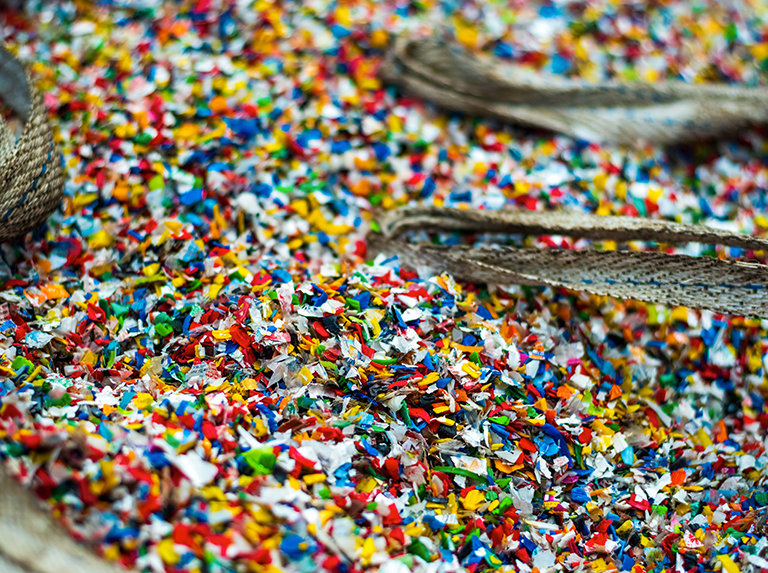
Yes, screws of this design are well-suited for processing recycled PVC provided the correct specification is selected to address the additional challenges that recycled material presents. Recycled PVC typically contains elevated levels of abrasive fillers such as calcium carbonate and kaolin, degraded or depleted stabilizer systems, variable particle size and bulk density, and occasional contamination — all of which place higher wear and thermal demands on the screw compared to virgin compound processing. For recycled PVC applications, upgraded specifications including tungsten carbide HVOF hard faced flight tips for maximum abrasion resistance are recommended. Processing parameters — particularly barrel temperatures, screw speed, and back pressure — should be carefully adjusted to compensate for the broader variability in thermal history and melt flow characteristics typical of recycled materials. Our engineering team can advise on the optimal specification and processing parameter window for your specific recycled PVC formulation and machine setup.
What is a matched pair of conical screws and why is it important?
A matched pair refers to the two screws — one left-hand helix and one right-hand helix — that are manufactured, dimensionally verified, and supplied together as a precisely coordinated set for installation in a counter-rotating twin-screw extruder. The matched pair is critical because the two screws must intermesh with extremely tight clearances — typically 0.05 to 0.15 mm between the flight tip of one screw and the flight root of the other — while rotating in opposite directions at the same speed. Any dimensional mismatch in taper angle, flight pitch, or outer diameter results in uneven clearances that cause differential wear, vibration, uneven melt distribution, and premature failure. At Hi-Tech Screw Barrel Works, both screws in every set are machined from the same heat of material, processed through the same nitriding cycle, measured on the same CMM to the same datum, and cross-checked for correct helix timing and balanced clearances before being approved as a matched pair.
What is tungsten carbide hard facing and when is it recommended?
Tungsten carbide hard facing is an advanced wear protection technique in which a tungsten carbide composite coating is applied to screw flight tips using the HVOF thermal spray process. In HVOF spraying, tungsten carbide particles are accelerated to extremely high velocities in a combustion jet and impacted onto the flight tip surface, forming a dense, strongly adherent coating with hardness values in the range of HV 1200–1400 — dramatically extending the interval before the flight-to-bore clearance grows beyond the acceptable limit for quality production. This upgrade is recommended for screws processing highly filled PVC formulations with calcium carbonate above 20 phr, WPC compounds with wood flour or rice husk, recycled PVC with variable filler content, glass-filled compounds, and any application where flight tip abrasion has been the primary failure mode in previous screw sets. The investment typically delivers two to three times the service life of a standard nitrided screw in these demanding conditions.
How should I select the right conical screw specification for my application?
Selecting the right specification involves matching the screw geometry, material, and surface treatment to the polymer being processed, the desired output rate, the extruder model and drive characteristics, and the operating environment. The key parameters to define include: screw size determined by the extruder model; L/D ratio governing the degree of plasticization and additive homogenization; compression ratio controlling the intensity of melt pressure generation; base material and surface treatment reflecting the abrasiveness and corrosivity of the compound; and whether optional wear upgrades such as tungsten carbide flight tip hardfacing are warranted. Our engineering team provides technical consultation as a standard part of the ordering process — reviewing the extruder model, material formulation, target output rate, and any existing wear history to recommend the optimal specification. Customers processing standard rigid PVC can typically be served from our standard range; those processing abrasive or recycled materials benefit from a tailored specification recommendation before placing an order.
What is the difference between gas nitriding and ion nitriding?
Both gas nitriding and ion plasma nitriding are thermochemical surface hardening processes that diffuse nitrogen into the steel surface to form a hard, wear-resistant compound layer, but they differ in process mechanism, controllability, and surface characteristics. Gas nitriding is carried out by exposing screws to a flowing ammonia atmosphere at 480–530°C in a sealed furnace — a well-established, reliable process delivering consistent hardness and case depth, ideal for standard applications. Ion nitriding uses an electrical plasma discharge in a low-pressure nitrogen-hydrogen atmosphere, offering superior controllability, the ability to minimise or eliminate the brittle white compound layer when required, and a smoother surface finish with lower residual stress — beneficial for screws with tighter dimensional tolerances or more complex flight geometries. The appropriate method is selected based on screw material, dimensional sensitivity, and application requirements, with all process parameters recorded and verified through test coupon analysis for every production batch.
How are conical screws packaged and delivered?
Careful and protective packaging is applied to all shipments to ensure that precision-machined components arrive at the customer’s facility in perfect condition. After final inspection, each screw is coated with a rust-preventive oil on all machined surfaces and wrapped individually in VCI poly film — Vapour Corrosion Inhibitor film that actively prevents oxidation during storage and transit. Wrapped screws are placed in foam-lined wooden crates or heavy-duty export-grade boxes with void fill to prevent movement during handling. Matched pairs are packed and labelled together, clearly identifying left-hand and right-hand screws to prevent installation errors. Each shipment is accompanied by a dimensional inspection certificate, material certificate, and surface hardness test report. Lead times for standard sizes are typically 2–4 weeks from order confirmation; custom and non-standard sizes generally require 4–8 weeks depending on complexity. Reliable logistics partners are used for both domestic and international shipments to ensure on-time delivery.
Why should plastic processors choose Hi-Tech Screw Barrel Works for their screw requirements?
Plastic processors choose Hi-Tech Screw Barrel Works because we bring together the three essentials that matter most in a precision engineering partner: deep technical expertise, advanced in-house manufacturing capability, and an unwavering commitment to quality. Our engineering team has accumulated over three decades of specialised knowledge in conical screw design and manufacture — translating directly into components optimised for the customer’s material, machine, and production goals. Our fully in-house manufacturing chain — CNC precision machining, dedicated nitriding furnaces, and calibrated CMM inspection — means every screw is produced under our direct quality control from raw material to finished component, with no outsourcing of critical processes. Our ISO 9001:2015 certified quality management system ensures this quality is documented, traceable, and consistent across every order. Beyond the product, we provide genuine ongoing technical partnership — advising on screw selection, supporting processing troubleshooting, and offering refurbishment services that maximise the value customers receive from every screw over its full working life. That sustained trust, built through consistent delivery, is the measure of who we are as a manufacturer, exporter, and supplier from Ahmedabad, Gujarat, India.
WHY CHOOSE US
Your Trusted Partner in Success
At Hi-Tech Screw Barrel Works, we are dedicated to providing top-tier services with a personal touch. With over 20+ years of experience and a proven track record of success, we prioritize your needs, ensuring customized solutions that drive results. Our team of experts stays ahead of industry trends, delivering innovative strategies tailored specifically for your business.
Unmatched Expertise
Experts in screw barrel manufacturing for 20+ years
State-of-the-Art Manufacturing
Precision screw barrels, high-tech manufacturing
Customer-Centric Approach
Personalized solutions with top-notch customer support













Expertise and Experience
With over 22 years of industry experience, we are leaders in the manufacturing of single screws, backed by a team of skilled professionals.

Advanced Manufacturing Facilities
Our state-of-the-art production facility is equipped with cutting-edge technology and CNC machines, ensuring precision and consistency in every component we manufacture.

Commitment to Quality
We adhere to stringent quality control standards throughout the manufacturing process, ensuring that each single screw meets our high-quality standards and exceeds customer expectations.

Customer-Centric Approach
We prioritize customer satisfaction and strive to provide personalized solutions and exceptional service. Our dedicated team is ready to assist you with technical expertise and support.