
- Home
- Conical Screw Barrel
Conical Screw Barrel
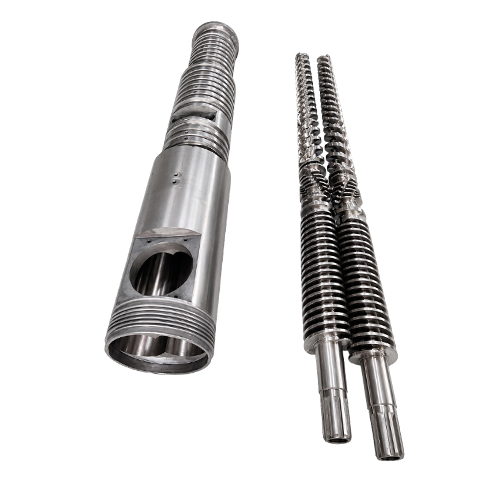
A conical screw barrel is a precision-engineered extrusion component used predominantly in twin-screw extruder machines. Unlike parallel screw barrels, conical screw barrels are designed with a tapered (conical) geometry — the screws are larger in diameter at the feed end and progressively taper to a smaller diameter at the discharge end. This distinctive geometry provides superior conveying, melting, and homogenization of thermoplastic materials, making it an indispensable component in the plastics processing industry.
Conical Screw Barrel
Price of Conical Screw Barrel
| Models |
Minimum Price (In Rs) |
Maximum Price (In Rs) |
|---|---|---|
|
65/132, 55/120, 51/105, 80/156 |
Rs. 2,80,000 |
Rs. 5,80,000 |
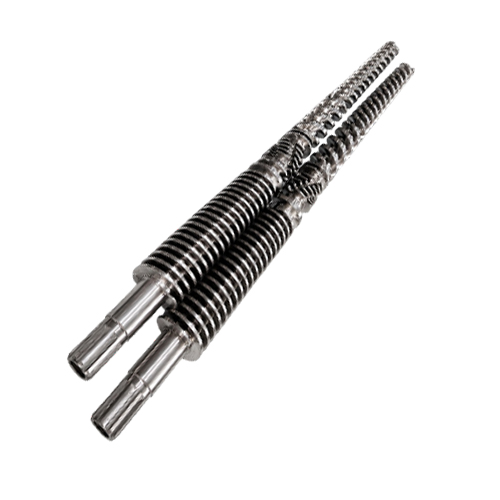
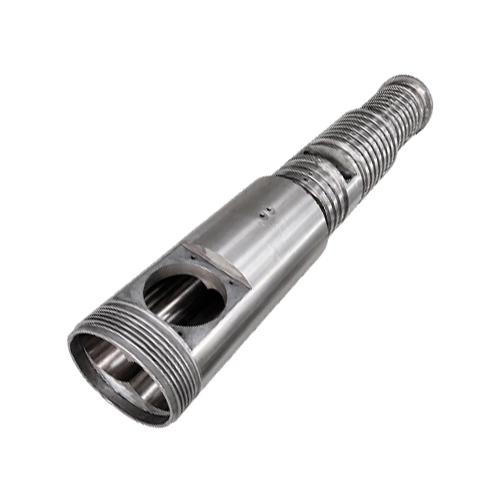
The conical screw barrel assembly consists of two interlocking, counter-rotating conical screws housed within a precisely bored, twin-bore conical barrel. The counter-rotating action of the twin screws creates a positive-displacement pumping effect, ensuring consistent output and excellent mixing. This component is specifically designed for processing rigid and plasticized PVC, ABS, and various thermoplastic compounds that demand gentle, controlled thermal treatment and high shear mixing capability.
Manufactured from high-grade tool steels such as 38CrMoAlA, Short SKD (A high-carbon, high-chromium, air-hardening cold-work tool steel) and bi-metallic alloys, the conical screw barrel offers outstanding wear resistance, corrosion resistance, and a prolonged service life even under the most demanding processing conditions. As a key working part of any PVC twin-screw extruder, the quality and precision of the conical screw barrel directly govern output consistency, product surface quality, energy consumption, and machine uptime.
Technical Specifications
| Specification | Technical Details |
|---|---|
|
Models |
65/132, 55/120, 51/105, 80/156 Etc. |
|
Material |
Bimetalli Type Or Short SKD Type Or Nitrided Type |
|
Surface Treatment |
Gas Nitriding, Hard Chrome Plating |
|
Surface Hardness |
65–68 HRC (500–550°C) |
|
Nitriding Depth |
0.5 mm to 0.6 mm |
|
Wear Protection |
Bimetallic Coating & Tungsten Carbide Coating On Screw, Barrel Bimetallic Sleeve Fitted & Short SKD Barrel |
|
Suitable Materials |
PVC, CPVC |
|
Suitable Industries |
PVC/CPVC Pipe Manufacturing, PVC Profile Manufacturing Etc. |
|
Suitable Machineries |
PVC/ CPVC Pipe Extrusion, PVC Profile Extrusion Etc. |
|
Condition |
New |
|
Stock |
As Per Order |
Types of Conical Screw Barrel
Salient Features
Conical (Tapered) Twin-Screw Design
The unique conical geometry ensures progressive compression, optimal melting zone distribution, and superior conveying efficiency from the large-diameter feed zone to the small-diameter discharge zone. This design eliminates the need for complex compression zone modifications to achieve the desired melt pressure.
Bimetallic Barrel Construction
The inner bore is centrifugally cast with a high-alloy wear-resistant lining (HRC 58–65) fused onto a sturdy outer steel body, delivering exceptional resistance to abrasion and corrosion for long operational life. Bimetallic barrels last 3–5 times longer than standard nitrided barrels.
High-Precision CNC Machining
All critical dimensions — screw OD, barrel bore, lead pitch, and root diameter — are machined on advanced CNC centers to micron-level tolerances, ensuring perfect inter-meshing and minimal clearance between the conical screws and barrel bore.
Superior Nitriding / Surface Hardening
Screw surfaces undergo gas nitriding or ion nitriding (surface hardness HRC 65-68, depth 0.4–0.6 mm), providing extreme wear resistance while maintaining core toughness and flexibility. Nitriding is done at sub-tempering temperatures to preserve dimensional accuracy.
Optimized Flight Geometry
Custom helix angles, flight depths, and compression ratios are engineered for specific materials and processing requirements, ensuring uniform melt quality and consistent throughput across the entire production run.
Corrosion-Resistant Alloys Available
For processing halogen-containing or chemically aggressive polymers such as PVC, special stainless steel or nickel-alloy-lined barrels are available to prevent chemical attack on barrel bore surfaces and extend service life.
Excellent Thermal Control
Barrels are equipped with multiple precisely zoned heating/cooling channels, enabling sharp thermal gradients across processing zones for tightly controlled melt temperature profiles essential for PVC processing.
Interchangeable & OEM Compatible
Our conical screw barrels are manufactured to match all major extruder brands. All Indian-make machines, making them ideal as both OEM and aftermarket replacement components.
Applications



Working Mechanism of Conical Screw Barrel
Feed Zone
Raw PVC compound or granules are gravity-fed or force-fed into the large-diameter feed opening. The large root diameter at the feed end creates high intake volume and efficient material pickup, ensuring a consistent and reliable supply of material into the processing zone without bridging or starve-feeding issues.
Compression Zone
As material moves forward, the tapering screw geometry progressively reduces the inter-screw volume, compressing the material and generating frictional heat that initiates melting. This natural compression, inherent to the conical design, builds melt pressure progressively and gently without mechanical stress on the material.
Melting Zone
Combined barrel heater heat and shear energy fully plasticize the material. The counter-rotating screw action creates a self-wiping effect that prevents material stagnation at the screw root and barrel wall, ensuring uniform thermal treatment and preventing localised thermal degradation of the PVC.
Mixing & Homogenization Zone
Intermeshing flights promote distributive and dispersive mixing of additives, stabilizers, lubricants, and pigments into the polymer melt, ensuring a uniform, homogeneous melt stream. The positive conveying action ensures all material passes through the mixing zone, eliminating unmixed pockets.
Why Choose Hi-Tech Screw Barrel Works
Three Decades of Application Engineering Knowledge
Hi-Tech Screw Barrel Works has been designing and manufacturing screw barrels for a wide range of polymer processing applications for over three decades. This accumulated knowledge enables our engineering team to move quickly from a customer’s application description to a complete and accurate screw geometry specification. We understand the relationship between screw geometry and processing performance across a wide range of polymers and processing conditions, and we apply this understanding to every canonical screw barrel project we undertake.
Complete In-House Manufacturing from Design to Dispatch
From initial engineering drawing preparation through CNC rough turning, precision flight machining, cylindrical grinding, dedicated nitriding, and final inspection — every stage of custom screw barrel production at Hi-Tech Screw Barrel Works is carried out in-house without outsourcing any critical manufacturing step. This complete in-house capability gives us full control over dimensional accuracy, surface quality, heat treatment consistency, and schedule — with a single point of accountability for the customer throughout the project.
Reverse Engineering and OEM Replacement Capability
Many customers approach Hi-Tech Screw Barrel Works with a worn or damaged screw barrel from an obsolete or non-standard extruder model and a requirement to reproduce it exactly. Our reverse engineering capability — using precision CMM measurement, 3D dimensional analysis, and CAD drawing preparation — allows us to take any physical sample, regardless of its condition, and produce a complete, accurate manufacturing drawing from which an exact replacement is produced. This service has enabled many customers to restore production lines that had been standing idle for lack of available spare components.
ISO 9001:2015 Certified Quality Management System
Every canonical screw barrel is manufactured and inspected under our ISO 9001:2015 certified quality management system, ensuring that all critical dimensions, surface treatments, and material specifications are verified at every stage of production. The complete documentation package supplied with every custom component gives customers the traceability and quality assurance they need for their own quality records, maintenance systems, and customer audit requirements.
FAQs
What is a conical screw barrel and how does it differ from a parallel screw barrel?
A conical screw barrel is a twin-screw extrusion component in which both the screws and the twin-bore barrel are tapered (conical) in shape — larger at the feed inlet and smaller at the discharge outlet. This is fundamentally different from a parallel screw barrel, where the screw diameter remains constant throughout the length. The conical geometry provides a natural volumetric compression from feed to discharge, generating progressive melt pressure without requiring complex screw flight modifications. This design is particularly advantageous for processing shear-sensitive materials like rigid PVC, as it minimises mechanical shear stress while ensuring thorough plasticization. Parallel barrels, on the other hand, are more suitable for high-throughput, high-torque compounding applications. In summary, for PVC pipe, profile, and sheet applications, conical screw barrels are the preferred and widely accepted industry standard due to their gentle processing characteristics and excellent output consistency.
What materials are used to manufacture conical screw barrels?
The manufacturing of conical screw barrels involves carefully selected high-performance engineering steels and alloys chosen for their wear resistance, toughness, and machinability. For screws, the most commonly used materials are 38CrMoAlA (a chromium-molybdenum-aluminium nitriding steel). After rough machining, screws undergo precision CNC finishing followed by gas nitriding or ion nitriding to achieve a surface hardness of HRC 65-68 with a depth of 0.4–0.6 mm. For barrels, the most popular construction is bimetallic — the outer body is made from 45# carbon steel or alloy steel, while the inner bore is centrifugally cast with a high-alloy wear-resistant layer (typically iron-based or nickel-based alloy with HRC 65-68 hardness) and Short SKD (A high-carbon, high-chromium, air-hardening cold-work tool steel). For processing corrosive materials like PVC, the inner bore can also be lined with stainless steel or special corrosion-resistant nickel alloys. The right material selection ensures the screw barrel delivers a long, trouble-free operational life even in abrasive and chemically aggressive processing environments.
Which industries and applications use conical screw barrels?
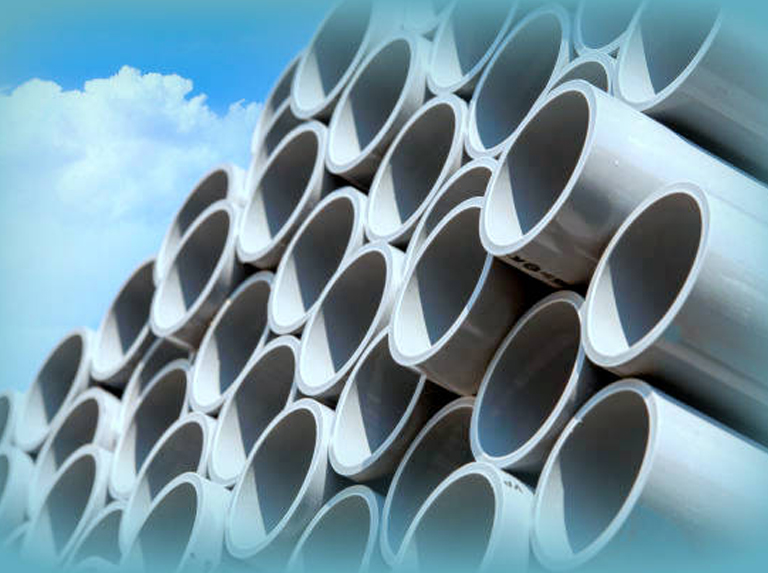
Conical screw barrels find extensive application across the plastics processing industry, with their primary use being in PVC pipe manufacturing — one of the largest segments of the global plastics industry. They are also indispensable in PVC door and window profile extrusion, wood-plastic composite (WPC) decking and fencing extrusion, and master batch and compound manufacturing. In the construction sector, conical screw barrels drive the production of uPVC pressure pipes, SWR drainage pipes, electrical conduits, and rigid foam PVC boards used in building applications. Automotive and electrical cable manufacturing industries also use them extensively. In emerging applications, conical screw barrels are now being deployed in CPVC pipe extrusion for hot water plumbing systems and in PVC foam board production for the furniture and signage industries. Their versatility, combined with superior handling of thermally sensitive materials, makes them the component of choice across all these varied yet critical industrial applications.
What are the standard sizes available for conical screw barrels?
Conical screw barrels are available in a wide range of sizes, typically defined by the feed-end screw diameter and the corresponding barrel bore diameter. Standard sizes commonly available in the market include 65/132, 80/156, 55/120 and 51/105 (feed-end screw diameter / barrel bore diameter in mm). These correspond to popular extruder models with output capacities ranging from approximately 80 kg/hour to over 600 kg/hour for rigid PVC applications. The L/D (Length-to-Diameter) ratio typically ranges from 16:1 to 22:1, with 18:1 and 20:1 being the most common for balanced plasticization and throughput. As a manufacturer, we also produce non-standard and custom sizes based on customer-supplied engineering drawings, specific machine models, or application-specific requirements. Customers from extruder OEMs, replacement parts distributors, and plastic product manufacturers regularly order custom sizes from us for specific machinery and production line needs. We recommend customers provide their extruder make, model, and serial number or engineering drawings for precise size matching.
How is the wear resistance of a conical screw barrel ensured?
Wear resistance in conical screw barrels is ensured through a combination of strategic material selection, precision heat treatment, and advanced surface engineering techniques. The screw flights are manufactured from high-alloy steels and subsequently subjected to gas nitriding or ion (plasma) nitriding processes, which diffuse nitrogen into the steel surface to form an ultra-hard compound layer and a diffusion zone beneath. This nitride layer achieves a surface hardness of HRC 60–65 at a depth of 0.4 to 0.6 mm — providing excellent wear resistance while the core remains tough and ductile. The barrel bore is lined with a centrifugally cast bimetallic wear layer, typically a high-chromium iron-based alloy or nickel-based alloy with similarly high hardness values. Additionally, for highly abrasive compound processing, tungsten carbide (WC) hardfacing can be applied to screw flight tips using thermal spray or welding overlay techniques. Regular clearance monitoring between screw flights and barrel bore is also recommended — a clearance exceeding 0.15–0.20 mm typically signals the need for refurbishment or replacement to maintain production quality and energy efficiency.
What is the typical service life of a conical screw barrel?
The service life of a conical screw barrel depends on a number of interrelated factors including the quality of the base material and heat treatment, the abrasiveness and corrosiveness of the material being processed, the operational running speed (RPM), the processing temperature profile, and the quality of routine maintenance. For standard rigid PVC processing applications with high-quality bimetallic barrels and nitrided screws, a service life of 8,000 to 15,000 operating hours is typically achievable before significant wear-related issues become apparent. In highly abrasive applications involving mineral-filled or recycled PVC, service life may be reduced to 4,000–8,000 hours. To maximise service life, operators are advised to maintain correct processing temperatures, avoid cold-start damage, use quality raw materials, and conduct quarterly or bi-annual dimensional checks of screw-barrel clearances. With proper refurbishment services such as chrome plating or tungsten carbide hardfacing of worn flight tips and re-honing of barrel bores, the effective life of a conical screw barrel assembly can often be extended by 50–100% at a fraction of the replacement cost.
How do I identify the right conical screw barrel for my extruder?
Identifying the correct conical screw barrel for your extruder requires gathering a few key pieces of information. First and most importantly, note the make and model of your extruder machine — for example, Cincinnati CM 55, Battenfeld KMD 4.65, or any Indian-manufactured equivalent. The extruder nameplate or technical documentation will also mention the nominal screw diameter(s) and the L/D ratio. If the nameplate is missing, a direct measurement of the existing screw’s feed-end and discharge-end outer diameters, overall length, and keyway dimensions will enable accurate matching. For the barrel, the bore diameter at both ends, the overall length, the flange bolt hole pattern, and the number and position of heater band zones and thermocouple ports are critical parameters. As your manufacturing partner, we can work from a physical sample of the old screw and barrel (even if worn), a complete dimensional drawing, or simply the extruder model number to supply a correctly matching replacement. Our team has an extensive database of conical screw barrel specifications for over 200 extruder models worldwide, enabling fast and accurate supply.
What is the difference between counter-rotating and co-rotating conical screw barrels?
Conical twin-screw extruders are almost universally designed as counter-rotating (the two screws rotate in opposite directions — one clockwise, the other anti-clockwise) rather than co-rotating (both screws rotating in the same direction). Counter-rotating conical screw barrels generate a positive-displacement pumping action in the nip region between the two screws, creating high pressure build-up with gentle, low-shear mixing characteristics. This makes them ideal for processing thermally and mechanically sensitive materials like rigid PVC, where excessive shear would cause degradation and discoloration. Co-rotating conical designs, though less common, generate higher distributive mixing intensity and are used in specific compounding applications. For the vast majority of PVC pipe, profile, and sheet extrusion applications in India and worldwide, counter-rotating conical screw barrels are the undisputed standard. Understanding this distinction is important when ordering replacement parts or designing new extrusion lines, as the screw helix direction and inter-flight clearances differ between the two configurations and are not interchangeable.
Can conical screw barrels be refurbished or repaired?
Yes, conical screw barrels can often be economically refurbished rather than fully replaced, providing significant cost savings particularly for larger sizes. Screw refurbishment typically involves inspection and measurement of all critical dimensions, building up of worn flight tips using tungsten carbide (WC) HVOF thermal spray or hard chrome plating, re-grinding of flights to original OD tolerances, and re-nitriding of the screw surface to restore surface hardness. For barrels, the bore can be re-honed after removing a thin layer of worn material, or in cases of severe wear, the bore can be re-bored and a new bimetallic sleeve can be pressed and bonded in place. The decision to refurbish versus replace depends on the degree of wear, the base material condition, and the remaining structural integrity of the component. As a manufacturer with full in-house machining and heat treatment capabilities, we offer comprehensive screw barrel refurbishment services from our Ahmedabad facility. Refurbishment can typically restore a worn screw barrel to 90–95% of its original dimensional and performance specifications at approximately 40–60% of the new component cost.
What quality standards are followed in conical screw barrel manufacturing?
Quality in conical screw barrel manufacturing is governed by a comprehensive set of standards and in-process controls applied at every stage of production. Our manufacturing processes conform to ISO 9001:2015 quality management system requirements, ensuring consistency, traceability, and continuous improvement across all production stages. Raw material quality is verified through material test certificates (MTCs) and independent chemical composition and hardness testing. During machining, CNC programs are validated and critical dimensions are checked at multiple stages using precision instruments including CMM (Coordinate Measuring Machines), surface profilometers, and calibrated plug/ring gauges. Post-nitriding hardness is verified using Rockwell hardness testers and the nitriding depth is confirmed through metallographic examination of test coupons. Final inspection includes 100% dimensional verification of all critical parameters, surface roughness measurement of the barrel bore, and visual inspection for surface defects. Dispatch is accompanied by a complete inspection report and quality certificate, giving our customers full traceability and confidence in every component supplied.
What is the importance of the L/D ratio in a conical screw barrel?
The L/D (Length-to-Diameter) ratio of a conical screw barrel is one of the most critical design parameters that governs the processing capability, output rate, melt quality, and energy efficiency of the extruder. In a conical screw barrel, the L/D ratio is typically calculated using the arithmetic mean of the feed-end and discharge-end screw diameters as the reference diameter. A higher L/D ratio (e.g., 22:1) provides a longer processing path, allowing more residence time for thorough melting, homogenization, and devolatilization, resulting in superior melt quality and better mixing of additives. A lower L/D ratio (e.g., 16:1) offers a shorter, more compact design suited for materials that melt easily and do not require extended plasticization. For rigid PVC pipe extrusion, L/D ratios between 18:1 and 22:1 are standard, balancing thorough plasticization against the need to minimise thermal residence time and prevent degradation. Changing the L/D ratio has direct implications for extruder frame design, heating zone count, throughput rate, and melt temperature, making it a fundamental parameter to specify correctly when ordering replacement or new screw barrels.
How does temperature control affect conical screw barrel performance?
Temperature control is absolutely fundamental to conical screw barrel performance and to the quality of the extrudate produced. The barrel is divided into multiple heating/cooling zones (typically 3 to 7), each controlled independently by a PID temperature controller connected to heater bands and cooling channels. The temperature profile across the barrel zones must be precisely matched to the thermal characteristics and processing window of the material being extruded. For rigid PVC, barrel temperatures typically range from 150°C at the feed zone to 185–195°C at the die zone, with the intermediate zones creating a carefully graduated temperature ramp. Excessively high temperatures cause thermal degradation of PVC, manifesting as discolouration, gas generation, and loss of mechanical properties. Insufficient temperatures result in incomplete plasticization, rough surface finish, and inhomogeneous melt, leading to defective products. The conical barrel’s multiple heating zones, combined with efficient water or air cooling channels, enable precise thermal management even at high production speeds.
What is the role of nitriding in conical screw barrel manufacturing?
Nitriding is one of the most critical surface hardening treatments applied to conical screws during manufacturing, and it plays a decisive role in determining the wear resistance, service life, and performance reliability of the component. During the nitriding process — either gas nitriding (using ammonia gas at 480–530°C) or ion (plasma) nitriding — nitrogen atoms diffuse into the steel surface to form a compound zone of iron nitrides with extremely high hardness (HRC 62–68), and beneath it a diffusion zone of nitrogen-enriched martensite. The resulting surface hardness of HRC 60–65 at a depth of 0.4–0.6 mm provides outstanding resistance to abrasion from filled or reinforced polymers, as well as excellent resistance to corrosion from halogen-containing polymers such as PVC. A key advantage of nitriding over alternative processes like case carburizing or hard chrome plating is that it occurs at relatively low temperatures (below the steel’s tempering temperature), so there is minimal dimensional distortion of the precision-machined screw geometry. This allows nitrided screws to maintain their tight dimensional tolerances while gaining a dramatically improved wear surface — making nitriding the industry standard surface treatment for high-performance conical screw barrels worldwide.
What is a bimetallic barrel and why is it preferred?
A bimetallic barrel is a twin-bore extruder barrel in which the bore surface is lined with a highly wear-resistant alloy layer that is metallurgically bonded to the outer structural steel shell. This construction is created through a centrifugal casting process: the alloy (typically a high-chromium iron-based or nickel-based composite containing hard carbide and boride phases) is cast in a liquid state into the rotating barrel bore, where centrifugal force distributes it uniformly and pressure-bonds it to the outer shell as it solidifies. The resulting inner layer, typically 1.5–3 mm thick with hardness up to HRC 65, provides exceptional wear and corrosion resistance to the bore surface in direct contact with the abrasive polymer melt. The outer structural steel provides the required mechanical strength, machinability, and thermal conductivity for heater band attachment. Bimetallic barrels are strongly preferred over single-material barrels because they significantly extend barrel service life (often 3–5 times longer than standard nitrided barrels), reduce operating costs, and maintain dimensional accuracy of the bore over a much longer production period, thereby ensuring consistently high product quality throughout the barrel’s operational lifetime.
What maintenance practices are recommended for conical screw barrels?
Proper maintenance of conical screw barrels is essential for sustaining production output, product quality, and maximising the component’s service life. Recommended maintenance practices include: regular dimensional checks (monthly or quarterly depending on production intensity) measuring screw OD at flight tips and barrel bore diameter using calibrated instruments to track wear progression and plan timely replacements before severe damage occurs. Correct purging procedures — purging with a compatible cleaning compound or natural HDPE at the end of each production run or before shutdown — prevent PVC charring and corrosive degradation inside the barrel. Operators should always follow proper warm-up and cool-down temperature profiles to avoid cold-start damage from hard residual PVC. Heater bands and thermocouples should be checked monthly for proper seating, contact quality, and functional accuracy. Visual inspection of screw tips and barrel flanges for scoring, cracking, or corrosion should be performed during every planned maintenance shutdown. Finally, maintaining a comprehensive maintenance log tracking operating hours, clearance measurements, and any anomalies greatly facilitates predictive maintenance planning and minimises unplanned downtime.
Can conical screw barrels process recycled PVC material?
Yes, conical screw barrels can process recycled PVC (RPVC) material, though certain design and operational considerations must be addressed to manage the additional challenges that recycled material presents. Recycled PVC often contains varying levels of contaminants, degraded stabilizer systems, higher levels of abrasive fillers (calcium carbonate, kaolin), and inconsistent particle size and bulk density compared to virgin PVC compound. These characteristics can accelerate wear on screw flight tips and barrel bore surfaces beyond the rate experienced with virgin material processing. To handle recycled PVC effectively, upgraded wear-protection is recommended: tungsten carbide (WC) hardfacing on screw flight tips via HVOF thermal spray, and a hard nickel-alloy bimetallic barrel bore, both provide significantly enhanced abrasion and corrosion resistance. Processing parameters including barrel temperatures, screw speed, and feed rate may need to be adjusted relative to virgin compound processing to compensate for variations in material thermal history and stabilizer content. With appropriately upgraded screw barrel assemblies and careful process optimisation, recycled PVC can be successfully extruded into quality pipe, profile, and sheet products with acceptable performance characteristics.
What causes premature wear in a conical screw barrel?
Premature wear in a conical screw barrel is typically caused by a combination of mechanical, chemical, and operational factors. The most common causes include: processing of highly abrasive compounds (such as those containing high loadings of calcium carbonate, talc, glass fibre, or wood flour) without appropriate wear-resistant screw and barrel specifications; cold-starting the extruder with solidified PVC inside the barrel, which places enormous mechanical stress on the screws and can cause severe scoring of flight tips and barrel bore. Chemical attack from hydrochloric acid (HCl) generated by PVC degradation — typically caused by inadequate stabilizer levels, excessive processing temperatures, or prolonged residence time — aggressively corrodes both screw and barrel surfaces. Running the extruder at excessive speed beyond the design RPM limit increases shear stress and metal-to-metal contact in the flight-bore clearance zone. Foreign contamination (metal fragments, stones, or hard agglomerates) entering with the raw material can cause catastrophic scoring and gouging. Poor-quality screw barrel components with inadequate heat treatment or substandard base material are also a frequent cause of premature failure. Identifying and addressing the root cause of excessive wear is critical — simply replacing a worn screw barrel without correcting the underlying cause will result in repeated premature failure.
How is a conical screw barrel installed and removed from the extruder?
The installation and removal of a conical screw barrel requires careful attention to procedure to prevent damage to precision components and ensure correct assembly for reliable operation. Prior to removal, the extruder should be purged thoroughly with a suitable cleaning compound and the barrel temperature should be raised to normal processing temperature to soften any residual plastic. The barrel clamps, flange bolts, heater bands, and thermocouple connections are sequentially disconnected, after which the barrel is carefully slid off the screws along the machine axis using a barrel removal tool or jig — avoiding any lateral forces that could score the bore or damage the screws. The screws are then withdrawn individually using screw extraction tools, applying even force along the axis. For installation of new or refurbished screws, all mating surfaces should be cleaned, inspected for burrs, and lightly lubricated on non-contact areas only. The screws are carefully inserted into the barrel while ensuring correct helix engagement, and the barrel is slid over the screws and aligned with the extruder gearbox flange. All flange bolts are torqued evenly in a cross pattern to the specified torque value to ensure uniform seating and prevent flange distortion.
Do you offer custom conical screw barrels for non-standard extruder models?
Absolutely. As an experienced manufacturer of conical screw barrels based in Ahmedabad, Gujarat, we specialise in both standard and fully custom-engineered screw barrel assemblies for non-standard, obsolete, or proprietary extruder models for which off-the-shelf replacements are unavailable. Our design and manufacturing team works closely with customers to understand the specific requirements — whether the customer provides a complete dimensional drawing, a worn sample of the existing screw or barrel, or simply the extruder make and model. Our engineering team uses reverse engineering techniques including precision CMM scanning, 3D metrology, and CAD modelling to recreate accurate manufacturing drawings from physical samples. We then manufacture the custom screw barrel using the appropriate material grade, heat treatment specification, and surface finish to match or exceed the OEM original specification. Custom orders can accommodate special L/D ratios, non-standard compression profiles, special flight geometries for specific polymers, special corrosion-resistant barrel bore alloys, and special flange configurations. Lead times for custom orders typically range from 3 to 8 weeks depending on complexity and size.
Why should I source conical screw barrels from a manufacturer in Ahmedabad, Gujarat, India?
Sourcing conical screw barrels from a manufacturer in Ahmedabad, Gujarat, India offers a compelling combination of advantages that make it an excellent procurement decision for buyers both within India and worldwide. India, and particularly Gujarat, has emerged as a world-class hub for engineering manufacturing, with Ahmedabad at its centre. Manufacturers here leverage decades of accumulated technical expertise, a highly skilled engineering workforce, and modern manufacturing infrastructure at cost structures significantly lower than equivalent European, American, or East Asian sources — translating directly into highly competitive pricing for end customers without sacrificing quality. Gujarat’s strategic location provides excellent connectivity to India’s major ports (JNPT Mumbai, Mundra, Pipavav) for efficient and cost-effective global exports. Indian manufacturers hold ISO 9001:2015 certifications and adhere to international standards (DIN, ISO, JIS), ensuring globally accepted quality levels. For domestic Indian buyers, sourcing locally eliminates import duties, customs delays, and foreign currency risks while providing the advantage of direct communication, rapid after-sales support, and quick availability of replacement parts. For international buyers, Indian-origin conical screw barrels represent excellent value-for-money with reliable quality, making Ahmedabad-based manufacturers the preferred sourcing destination for buyers across Africa, Southeast Asia, the Middle East, and beyond.
WHY CHOOSE US
Your Trusted Partner in Success
At Hi-Tech Screw Barrel Works, we are dedicated to providing top-tier services with a personal touch. With over 20+ years of experience and a proven track record of success, we prioritize your needs, ensuring customized solutions that drive results. Our team of experts stays ahead of industry trends, delivering innovative strategies tailored specifically for your business.
Unmatched Expertise
Experts in screw barrel manufacturing for 20+ years
State-of-the-Art Manufacturing
Precision screw barrels, high-tech manufacturing
Customer-Centric Approach
Personalized solutions with top-notch customer support



















Expertise and Experience
With over 22 years of industry experience, we are leaders in the manufacturing of single screws, backed by a team of skilled professionals.

Advanced Manufacturing Facilities
Our state-of-the-art production facility is equipped with cutting-edge technology and CNC machines, ensuring precision and consistency in every component we manufacture.

Commitment to Quality
We adhere to stringent quality control standards throughout the manufacturing process, ensuring that each single screw meets our high-quality standards and exceeds customer expectations.

Customer-Centric Approach
We prioritize customer satisfaction and strive to provide personalized solutions and exceptional service. Our dedicated team is ready to assist you with technical expertise and support.