
- Home
- Blow Molding Screw Barrel
Blow Molding Screw Barrel
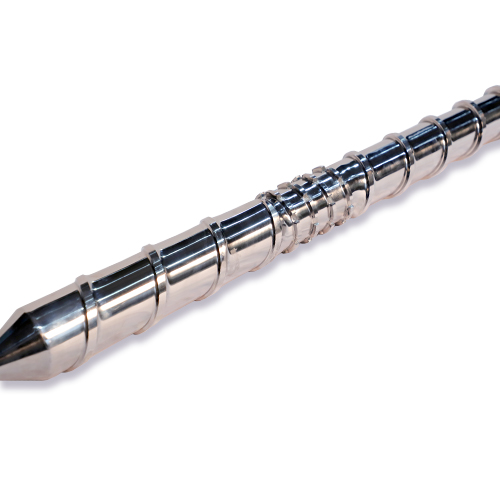
Blow molding screw barrel is a crucial components in the blow molding process, designed to melt and extrude thermoplastic materials into a parison (hollow tube) which is then shaped within a mold cavity to form finished plastic products. These screw barrels are engineered to withstand high temperatures, pressures, and the unique demands of blow molding operations.
Hi-Tech Screw Barrel Works is a dedicated blow molding screw barrel manufacturer and supplier in India, serving the plastic processing industry since 2000 from our integrated manufacturing facility in Ahmedabad, Gujarat.
We supply precision-engineered assemblies across a screw diameter range of 20 mm to 200 mm. Covering all major blow molding process types, polymer grades, and machine brands operating in the Indian and export markets.
Blow Molding Machine Screw Barrel
Download Brochure
Price of Blow Molding Machine Screw Barrel
|
Screw Minimum Size (mm or inch) |
Screw Maximum Size (mm or inch) |
Barrel Minimum Size (mm or inch) |
Barrel Maximum Size (mm or inch) |
Minimum Price (In Rs) |
Maximum Price (In Rs) |
|---|---|---|---|---|---|
|
20mm |
250mm |
20mm |
250mm |
Rs. 35,000 |
Rs. 15,00,000 |
The Production Process
Our competitors list specifications. We manufacture to them. Understanding our production process helps procurement engineers and plant managers evaluate why Hi-Tech assemblies consistently outperform locally traded or import-sourced alternatives.
Stage 1 - Raw Material Inspection & Traceability
Every blow molding screw barrel assembly begins with certified alloy steel: 4140/42CrMo4 for standard duty, 1.2344 (H13) or 1.2379 (D2) for premium and corrosive service. Incoming billets are verified against mill test certificates for chemical composition (C, Cr, Mo, V percentages) and mechanical properties before release to the shop floor. No material enters the machining stage without documented traceability – a practice that differentiates ISO-certified manufacturers from the unorganised trade suppliers that also populate the Indian market.
Stage 2 — CNC Rough Turning & Stress Relieving
Screw blanks are rough-turned on CNC lathes to within 0.5 mm of the final outer diameter, then stress-relieved in a controlled-atmosphere furnace at 550-600°C for 4-6 hours. This intermediate heat treatment eliminates the residual machining stresses that cause dimensional drift during final finish grinding – a step frequently omitted by low-cost producers, resulting in screws that go out of tolerance after the first thermal cycle in service.
Stage 3 - Flight CNC Milling & Flight Tip Induction Hardening
Screw flights are milled using CNC 5-axis machining centres to achieve the precise helix angle, pitch, and flight geometry specified for the polymer – whether a standard single-flight HDPE screw, a barrier-flight design, or a PVC-specific low-compression profile. Flight tips are then selectively induction hardened to 60-65 HRC on premium-grade assemblies, creating a wear-resistant surface precisely where metal-to-bore contact stress is highest.
Stage 4 - Ion Nitriding (White-Layer-Free)
Screw flights are milled using CNC 5-axis machining centres to achieve the precise helix angle, pitch, and flight geometry specified for the polymer – whether a standard single-flight HDPE screw, a barrier-flight design, or a PVC-specific low-compression profile. Flight tips are then selectively induction hardened to 60–65 HRC on premium-grade assemblies, creating a wear-resistant surface precisely where metal-to-bore contact stress is highest.
Stage 5 - Bimetallic Barrel Centrifugal Casting & Bonding
For bimetallic barrel variants, the wear-resistant alloy liner (Fe-Cr-C or Ni-WC matrix) is centrifugally cast at controlled rotation speed and temperature to achieve a uniform, pore-free liner thickness of 1.5–3.0 mm. The metallurgical bond between the alloy liner and the structural steel outer tube is verified by cross-section examination before the barrel proceeds to boring and honing.
Stage 6 - Deep-Bore Precision Honing
Barrel bores are finish-honed on dedicated deep-bore honing machines to bore straightness of ≤ 0.05 mm/m and surface roughness of Ra ≤ 0.4 µm (standard) or Ra ≤ 0.2 µm (polished/medical grade). This is the final bore dimension that determines the screw-to-barrel radial clearance – the single most important assembly parameter for output rate efficiency and melt pressure stability.
Stage 7 - Final Inspection & Dimensional Certification
Every completed blow molding screw barrel assembly is measured on CMM (co-ordinate measuring machine) equipment against a 12-point inspection checklist: screw OD at 3 axial positions, flight hardness at 3 points, bore ID at 3 axial positions, bore roundness, bore surface roughness, and overall assembly straightness. An inspection certificate with actual measured values – not nominal values – accompanies every shipment.
Lead Times & Supply Format
As a reliable blow molding screw barrel supplier serving customers across India and export destinations, Hi-Tech maintains raw material inventory and standard-diameter machined blanks to support compressed delivery schedules. The table below reflects current lead-time commitments:
| Supply Category | Diameter Range | Specification | Lead Time |
|---|---|---|---|
|
Standard Replacement |
40–100 mm |
4140 nitrided, L/D 20:1–22:1 |
7–14 working days |
|
Bimetallic Barrel |
40–150 mm |
Bimetallic liner, standard L/D |
12–18 working days |
|
Custom-Engineered |
20–200 mm |
Special geometry, barrier, co-ex sets |
15–25 working days |
|
Urgent Replacement |
40–100 mm |
Standard catalogue sizes only |
3–5 working days* |
|
Reverse-Engineered |
Any |
From worn sample, no drawing needed |
15–20 working days |
*Urgent supply subject to material stock availability. Confirm with Hi-Tech sales team at order stage.
Dispatch from Ahmedabad covers all major plastics processing clusters in India – Surat, Vapi, Pune, Chennai, Delhi NCR, Hyderabad – within 24–48 hours of goods ready via road freight or air courier for urgent parts.
Quality Certifications & Manufacturing Standards
Hi-Tech Screw Barrel Works operates under an ISO 9001:2015 certified quality management system, audited by an accredited third-party certification body. The QMS governs every stage from raw material procurement to finished goods dispatch. For buyers evaluating blow molding screw barrel manufacturers in India, the following quality commitments are contractually applicable:
• Material traceability: mill test certificates on file for every batch of alloy steel used
• In-process hardness testing at nitriding stage: each screw tested at 3 axial positions with calibrated Rockwell tester
• Dimensional inspection: CMM measurement against 12-point checklist on 100% of assemblies
• Surface roughness verification: profilometer measurement of bore Ra on every barrel
• Inspection certificate: supplied with each shipment, showing actual (not nominal) measured values
• Packing: screws packed in PE-lined corrugated boxes with bore and flight protection; barrels packed in wooden crates for inter-state and export shipments
OEM Machine Compatibility
Hi-Tech supplies replacement blow molding screw barrel assemblies compatible with all major machine brands operating in the Indian market. Buyers need not source from expensive OEM spares channels. Hi-Tech delivers equivalent or superior specification at 35–55% of OEM spare parts pricing, with comparable or shorter lead times.
Benefits
Precision Melt Control and Distribution
Blow molding machine screw barrels ensure precise melt control and distribution of molten plastic, resulting in uniform wall thickness and superior part aesthetics. This enhances product quality and reduces material waste.
Enhanced Wear Resistance and Durability
Our screw barrels are manufactured from high-grade materials such as nitrided steel, bimetallic alloys, and tungsten carbide coatings, offering exceptional wear resistance and durability. This extends service life and reduces maintenance costs.
Optimized Processing Parameters
By optimizing screw design and material selection, our screw barrels improve processing parameters such as cycle time, cooling efficiency, and dimensional accuracy. This enhances production efficiency and reduces overall manufacturing costs.
Customization Options
We offer customization options to meet specific customer requirements, including screw diameter, length-to-diameter ratio (L/D), flight geometry, material composition, and surface coatings. Our engineering expertise ensures that each blow molding machine screw barrel is tailored for maximum performance and reliability.
FAQs
What is the function of a screw barrel in a blow molding machine?
The screw barrel in a blow molding machine is responsible for melting, homogenizing, and conveying plastic material before it is formed into a parison or preform. It ensures proper material flow, maintains consistent temperature, and provides uniform plasticization for high-quality molded products.
What materials are used to manufacture blow molding machine screw barrels?
High-quality nitrided steel, bimetallic alloys, and hardened tool steel are commonly used to enhance durability, wear resistance, and corrosion protection. These materials extend the life of the screw barrel, especially when processing abrasive or high-temperature plastics.
How does screw design impact blow molding performance - and which design is right for my application?
Screw design directly affects melting rate, mixing quality, and output consistency. A well-matched design ensures uniform temperature distribution, reduces shear stress, and delivers defect-free, high-strength products.
The three most common designs are:
• Single screw – a general-purpose design suited to standard plasticizing requirements and commodity resins.
• Barrier screw – incorporates additional flight barriers that physically separate melted and unmelted plastic, improving mixing uniformity, reducing cycle times, and enhancing overall output quality. Preferred for demanding applications and engineering resins.
• Vented (two-stage) screw – features a decompression zone and vent port in the barrel to evacuate moisture and volatiles. Essential for recycled HDPE, regrind-heavy lines, and hygroscopic materials where surface defects and bubble formation are a concern.
Hi-Tech recommends the appropriate design based on your material, output rate, and quality requirements.
How long does a blow molding screw barrel last - and what are the signs it needs replacement?
Service life depends on four factors: base material quality, surface treatment type, the abrasiveness of resins processed, and maintenance discipline. On a well-maintained line processing standard HDPE or PP, a premium screw barrel assembly typically delivers a 2–3 year production cycle before performance degradation.
Signs that replacement or reconditioning is needed:
• Inconsistent material flow or output surging
• Increased cycle times without process changes
• Excessive heat generation or energy draw
• Visible wear on screw flights (measurable flight clearance increase)
• Recurring product defects such as weld lines, incomplete plasticization, or surface streaks
Why surface treatment matters for lifespan: Import-sourced assemblies commonly use gas nitriding, which leaves a brittle white layer that spalls under thermal cycling. Hi-Tech’s standard process is ion nitriding (plasma nitriding), which is white-layer-free, produces a deeper and tougher diffusion zone, and consistently outlasts gas-nitrided equivalents in comparative wear testing. Bore finish is held to Ra ≤ 0.4 µm versus the Ra 0.6–1.2 µm typical of import-grade assemblies. On a total cost of ownership basis – accounting for service life, unplanned downtime, and the absence of local technical support on imported equipment – Hi-Tech assemblies deliver lower cost per kilogram of output over comparable production cycles.
Regular cleaning, controlled processing temperatures, and using wear-resistant bimetallic or HVOF-coated configurations for abrasive materials will extend service life further.
Can a blow molding screw barrel be customized for different plastics - including recycled materials?
Yes. Screw barrels are engineered to the specific demands of the resin being processed. Different materials require different screw geometries, compression ratios, and surface treatments.
Standard material configurations:
• HDPE / PP – standard nitrided or bimetallic barrel with a general-purpose or barrier screw
• PVC – corrosion-resistant barrel lining (e.g., Xaloy 306 equivalent bimetal) with a low-shear screw profile to prevent thermal degradation
• PET / engineering resins – tight-clearance, high-polish bore finish with a barrier or mixing screw
Recycled HDPE – special considerations: Recycled HDPE introduces variable contamination (metal particles, paper, mixed polymers) and elevated moisture from inadequately dried regrind. Hi-Tech’s recommendations for recycled content lines:
• 25–75% recycled content: bimetallic barrel with HVOF-coated screw flights for abrasion resistance
• 100% post-consumer HDPE: vented (two-stage) screw with a barrel vent port to evacuate moisture and volatiles – eliminates the bubble formation and surface defects that occur on non-vented assemblies processing undried recycled material
All configurations are available as standard or custom-engineered assemblies.
How does barrel heating affect the blow molding process?
Proper barrel heating ensures uniform plastic melting, reduces material degradation, and improves energy efficiency. Inconsistent heating can cause defects like incomplete plasticization, air bubbles, or weak product structure.
How do I place an order - what is the MOQ, lead time, and process if I don't have the original drawing?
Minimum order quantity: Hi-Tech accepts single-piece orders for both standard replacement and custom-engineered assemblies. There is no minimum order quantity. Single-piece supply is common for MRO replacement requirements; batch orders are produced to the same quality standard with volume pricing available for OEM builders requiring identical assemblies in quantity.
Lead time: Typically 2–6 weeks depending on design complexity, material selection, and current production schedule. Custom-engineered or reverse-engineered assemblies are quoted individually.
No drawing? No problem: Submit the worn screw and/or barrel to Hi-Tech’s facility in Ahmedabad. Our metrology team measures component geometry on CNC co-ordinate measuring equipment, produces a full dimensional report, and manufactures the replacement to the recovered geometry. Reverse-engineering from a submitted sample is included in the assembly price – there is no separate engineering charge for standard samples.
What is the difference between a blow molding screw barrel manufacturer and a supplier - and how do I verify I am buying from a genuine manufacturer?
A supplier may source from third-party manufacturers and resell – common among trading companies and many IndiaMART-listed intermediaries. A manufacturer produces in-house, controls the full production process, and can provide dimensional traceability and material certification. The practical difference to a buyer: a trader typically cannot provide material mill certificates or in-house inspection reports; a genuine manufacturer can.
To verify manufacturer status, ask for:
1. Material mill certificates (traceable to the heat/batch of steel used)
2. In-house inspection reports with dimensional data
3. ISO 9001:2015 certificate – check that the scope explicitly covers “manufacture of screw barrels / extrusion screws”, not just the company’s other activities
Hi-Tech is a manufacturer: every blow molding screw barrel assembly is machined, heat-treated, and inspected at our Ahmedabad facility. Our ISO 9001:2015 certificate scope covers screw barrel manufacture and is available for verification on request.
What are the signs that my blow molding barrel heating system needs attention?
Proper barrel heating ensures uniform plastic melting, reduces material degradation, and improves energy efficiency. Inconsistent heating manifests as incomplete plasticization, air bubbles in the parison, or structurally weak finished products. Regular inspection of heater bands, thermocouples, and PID controller calibration is recommended as part of scheduled maintenance.
Do you provide technical support for installation and maintenance?
Yes, we provide complete technical support including installation guidance, troubleshooting assistance, and maintenance services to ensure optimal performance and longevity of your blow molding machine screw barrel.
Why Choose Us?

Expertise and Experience
With over 22 years of industry experience, we are leaders in the manufacturing of single screws, backed by a team of skilled professionals.

Advanced Manufacturing Facilities
Our state-of-the-art production facility is equipped with cutting-edge technology and CNC machines, ensuring precision and consistency in every component we manufacture.

Commitment to Quality
We adhere to stringent quality control standards throughout the manufacturing process, ensuring that each single screw meets our high-quality standards and exceeds customer expectations.

Customer-Centric Approach
We prioritize customer satisfaction and strive to provide personalized solutions and exceptional service. Our dedicated team is ready to assist you with technical expertise and support.