
- Home
- Conical Screw Barrel
- Conical Barrel
Conical Barrel
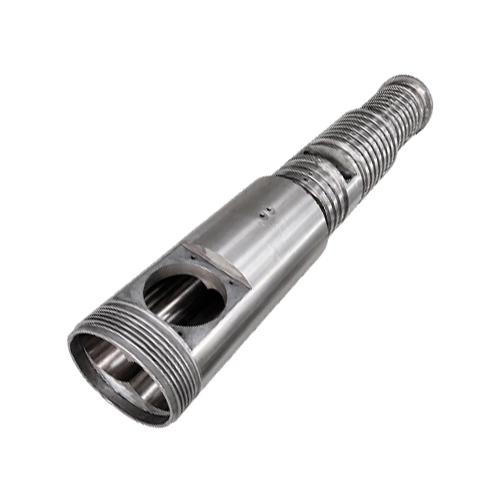
A conical barrel is a precision-engineered extrusion component that forms the stationary housing of a conical twin-screw extruder. It is a twin-bore barrel — containing two intersecting, conically tapered bores that precisely mirror the geometry of the two conical screws rotating within it. The barrel’s inner surface is in constant, intimate contact with the rotating screws and the polymer melt being processed, making it one of the most critically stressed components in the entire extrusion system. Its dimensional accuracy, surface integrity, and material quality directly govern the quality of the extrudate, the energy efficiency of the process, and the overall service life of the extruder.
Conical Barrel
Price of Conical Barrel
| Models |
Minimum Price (In Rs) |
Maximum Price (In Rs) |
|---|---|---|
|
65/132, 55/120, 51/105, 80/156 |
Rs. 1,40,000 |
Rs. 2,90,000 |
Unlike a parallel barrel used in standard twin-screw extruders, the conical barrel is tapered along its length — larger at the feed end where raw polymer compound is introduced, and progressively narrowing toward the discharge end where the plasticised melt exits under pressure into the die head. This tapered geometry works in direct geometric harmony with the conical screws it houses, creating the progressive compression and positive-displacement conveying action that defines this extrusion technology.
At Hi-Tech Screw Barrel Works, every conical barrel is manufactured to the highest standards of dimensional accuracy and material performance. Using advanced CNC boring and honing equipment, dedicated bimetallic centrifugal casting facilities, and comprehensive in-process quality controls, we produce barrels that deliver consistent processing performance, extended wear life, and reliable long-term operation in PVC pipe, profile, sheet, and compound extrusion applications.
Hi-Tech Screw Barrel Works is a trusted manufacturer, exporter, and supplier of conical barrels serving PVC pipe plants, profile extrusion facilities, compounding units, and extruder OEMs — backed by decades of specialised engineering expertise and an ISO 9001:2015 certified manufacturing process.
Technical Specifications
| Specification | Technical Details |
|---|---|
|
Models |
65/132, 55/120, 51/105, 80/156 Etc. |
|
Material |
Bimetallic Type Or Short SKD Type Or Nitrided Type |
|
Surface Treatment |
Gas Nitriding |
|
Surface Hardness |
65–68 HRC (500–550°C) |
|
Nitriding Depth |
0.5 mm to 0.6 mm |
|
Wear Protection |
Barrel Bimetallic Sleeve Fitted & Short SKD Barrel |
|
Suitable Materials |
PVC, CPVC |
|
Suitable Industries |
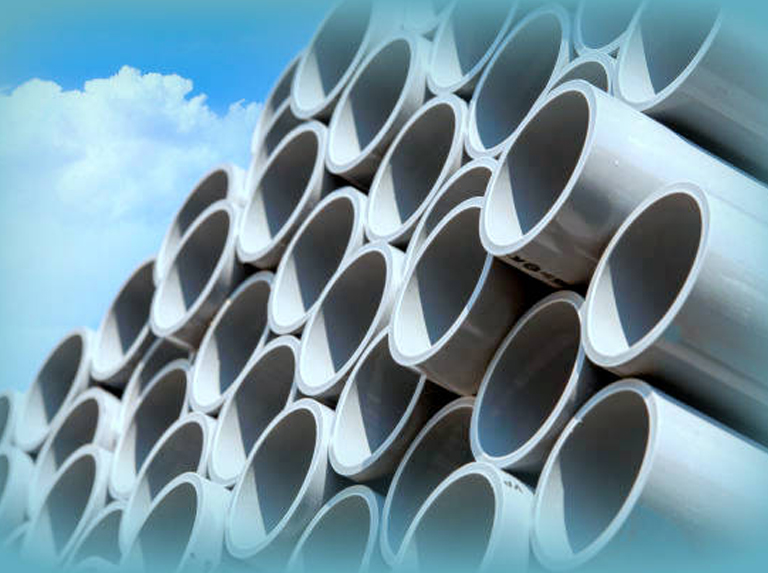
PVC/CPVC Pipe Manufacturing, PVC Profile Manufacturing Etc. |
|
Suitable Machineries |
PVC/ CPVC Pipe Extrusion, PVC Profile Extrusion Etc. |
|
Condition |
New |
|
Stock |
As Per Order |
Salient Features of Conical Barrel
Precision Twin-Bore Conical Geometry
Each conical barrel is bored to a precisely tapered twin-bore profile that exactly matches the geometry of the corresponding conical screws. The taper angle, bore diameter at the feed and discharge ends, and the centreline distance between the two bores are all machined to micron-level tolerances, ensuring correct screw-to-barrel clearance and uniform melt distribution across the full barrel length.
Bimetallic Construction — Centrifugally Cast Wear Liner
The outer body is manufactured from robust structural alloy steel, while the inner bore surfaces are lined with a centrifugally cast, high-alloy wear-resistant layer. This alloy liner — typically an iron-based or nickel-based composite with hard carbide and boride phases — achieves a bore surface hardness of HRC 65-68 and provides outstanding resistance to abrasive and corrosive wear from polymer melts, fillers, and hydrochloric acid generated during PVC processing.
High-Hardness Bore Surface
The centrifugally cast alloy liner achieves a bore surface hardness of HRC 65-68 — significantly harder than a standard nitrided bore surface. This high hardness ensures the bore retains its dimensional accuracy under prolonged abrasive wear conditions, maintaining the correct screw-to-bore clearance for consistent output pressure and product quality over thousands of operating hours.
Mirror-Honed Bore Finish
Following bimetallic casting and rough boring, the bore surfaces are precision honed to a mirror-like finish of Ra ≤ 0.4 µm. This smooth, low-friction surface minimises material adhesion on the bore wall, reduces the risk of localised polymer degradation at stagnation points, promotes efficient melt flow from feed to discharge, and facilitates faster, cleaner purging between material and colour transitions.
Multiple Precision Heating and Cooling Zones
The conical barrel is equipped with multiple independently controlled heating and cooling zones — typically three to seven depending on the extruder model — allowing the operator to establish a precise temperature profile along the barrel length. Each zone is fitted with accurately positioned heater band seats machined to close tolerances, and cooling channels — either air-cooled ducts or water-cooled bores — for rapid thermal response essential for processing rigid PVC and other thermally sensitive materials.
Corrosion-Resistant Bore Alloy Options
For processing halogen-containing polymers such as PVC, CPVC, and chlorinated compounds, Hi-Tech Screw Barrel Works offers barrels with specialised nickel-alloy or stainless-steel bore linings specifically selected for superior resistance to acid corrosion, extending bore service life in these chemically aggressive processing environments.
Precision Flange Machining and Bolt Circle
The feed-end and discharge-end flanges are precision-machined to close tolerances on face flatness, perpendicularity, and bolt-circle pitch circle diameter. Correct flange geometry ensures leak-free assembly at the gearbox interface and die head connection, prevents melt leakage under high processing pressure, and ensures correct axial alignment with the extruder centreline.
CNC Machined Heater Band and Thermocouple Seats
All heater band seating surfaces and thermocouple port locations are CNC machined to close-tolerance dimensions, ensuring intimate, uniform contact between the heater bands and barrel body for efficient heat transfer, and accurate, reproducible thermocouple positioning for reliable PID temperature control performance.
Applications



Working Mechanism of the Conical Barrel
Feed Zone
At the large-diameter feed end, the barrel receives raw PVC compound from the hopper. The bore diameter at this end is at its maximum, creating a large inter-screw free volume that promotes high, consistent material intake. The barrel wall in this zone is typically lightly heated to promote initial material compaction without premature melting.
Compression Zone
As material advances into the tapered compression section, the bore wall progressively narrows in step with the screw geometry. The bore wall applies back-pressure and conductive heat from the heater bands to the advancing material, compressing it and initiating the melting process. Bore surface quality directly affects the efficiency of heat transfer and the consistency of compression.
Melting Zone
In the melting zone, the barrel’s heater bands deliver the majority of the thermal energy required to plasticize the PVC compound. Multiple independently controlled heating zones allow the operator to shape the temperature profile precisely, ensuring complete plasticization without exceeding the thermal degradation threshold of PVC. The bore surface acts as both a thermal conductor and a reaction surface that, together with the screw flight action, drives melt homogenization.
Mixing and Homogenization Zone
The precision bore geometry in the mixing zone maintains the correct screw-to-bore clearance that governs the shear rate applied to the melt. An accurate, consistent clearance — maintained by the high hardness and dimensional stability of the bimetallic bore liner — ensures uniform shear intensity across the full working cross-section, producing a homogeneous melt with uniform additive dispersion and consistent melt viscosity.
Why Choose Hi-Tech Screw Barrel Works
Engineering Expertise Built Over Decades
Our engineering team possesses deep, application-specific knowledge of barrel design, bimetallic construction, and the relationship between bore geometry, surface quality, and extrusion performance. This enables us to manufacture barrels precisely optimised for the processing demands of each customer’s application — whether standard rigid PVC pipe production or a demanding high-filler compound formulation.
In-House Bimetallic Casting and CNC Boring
Hi-Tech Screw Barrel Works operates dedicated centrifugal casting equipment for bimetallic bore liner application, combined with precision CNC horizontal boring machines and high-precision honing equipment for bore finishing. This end-to-end in-house capability gives complete control over bore liner quality, dimensional accuracy, and surface finish at every stage of production.
ISO 9001:2015 Certified Quality System
Every barrel leaving our facility is backed by an ISO 9001:2015 certified quality management system. Bore diameter is measured at multiple cross-sections along the barrel length. Bore surface hardness is checked on the cast liner. Bore liner bonding integrity is verified by ultrasonic testing. Each barrel is dispatched with a complete dimensional inspection certificate and quality report, providing full manufacturing traceability.
OEM and Custom Manufacturing Capability
Hi-Tech Screw Barrel Works is a preferred OEM manufacturing partner for extruder builders and plastic processors requiring barrels to exact engineering drawings, specific bore alloy grades, and proprietary dimensional specifications. We work from customer drawings, reverse-engineered worn barrel samples, or extruder model references to deliver replacements that match or exceed original equipment standards.
Bore Refurbishment and After-Sales Support
Beyond new manufacture, we offer comprehensive bore refurbishment services. Worn bores can be re-bored and re-lined with new bimetallic sleeves, or re-honed for minor wear restoration. Our technical team provides ongoing support for maintenance planning, bore wear monitoring, and specification guidance for replacement barrels.
Manufacturer, Exporter and Supplier — Ahmedabad, Gujarat, India
Hi-Tech Screw Barrel Works is a leading manufacturer, exporter, and supplier of precision conical barrels based in Ahmedabad, Gujarat, India. Our strategic location provides access to major ports for reliable export to the Middle East, Africa, Southeast Asia, and Europe. We supply to plastic pipe manufacturers, profile extrusion units, compounding plants, and extruder OEMs across India and worldwide, with competitive pricing, reliable logistics, and on-time delivery backed by our ISO 9001:2015 certified manufacturing process.
FAQs
What is a conical barrel and what is its function in a twin-screw extruder?
A conical barrel is the precision-machined, twin-bore housing of a twin-screw extruder within which the two counter-rotating screws rotate and the polymer melt is processed. Its function goes beyond simply containing the screws. The tapered bore geometry works in harmony with the conical screws to generate progressive compression from the large-diameter feed end to the small-diameter discharge end. The barrel’s heater bands and cooling channels establish and maintain the precise temperature profile required for complete, uniform plasticization of the polymer compound. The bore surface — hardened, honed, and dimensionally precise — maintains the correct clearance with the screw flight tips that governs shear rate, output pressure, and melt quality. The quality of the conical barrel is therefore directly linked to the output consistency, product quality, energy efficiency, and maintenance costs of the entire extrusion operation. At Hi-Tech Screw Barrel Works, every barrel is manufactured to the exacting standards required to fulfil all these functions reliably throughout a long operational life.
What is bimetallic construction and why is it important for a conical barrel?
Bimetallic construction refers to the design where the outer structural steel body is combined with a high-alloy wear-resistant inner bore lining that is centrifugally cast and metallurgically bonded to the inner surface of the outer body. The centrifugal casting process introduces a molten high-alloy composite — typically iron-based or nickel-based — into the rotating barrel bore, where centrifugal force distributes it uniformly and bonds it to the outer shell as it solidifies. The resulting liner, typically 1.5 to 3 mm thick, achieves a bore surface hardness of HRC 58–65 — significantly harder than a standard nitrided bore surface. Bimetallic construction is important because the bore surface is in continuous contact with abrasive polymer melts, mineral fillers, and corrosive processing by-products throughout the barrel’s operational life. The hard, wear-resistant liner dramatically extends service life of the bore, maintaining dimensional accuracy for a much longer period and ensuring consistent output pressure, uniform melt distribution, and sustained product quality throughout the barrel’s service life.
How does the conical barrel contribute to PVC processing performance?
The conical barrel makes a fundamental contribution to PVC processing performance through three distinct mechanisms: thermal management, bore geometry, and bore surface quality. In terms of thermal management, the barrel’s multiple independently controlled zones allow the operator to establish and maintain a precise temperature profile — critical for PVC, which has a narrow thermal processing window between plasticization and thermal degradation. In terms of bore geometry, the barrel’s precise taper and bore dimensions define the compression ratio and maintain the correct screw-to-bore clearance that governs output pressure and melt quality. In terms of bore surface quality, the mirror-honed, hard bore liner minimises melt adhesion on the bore wall and prevents the localised stagnation and degradation of PVC that can cause black specks, burnt spots, and colour inconsistencies in the final product. Every conical barrel from Hi-Tech Screw Barrel Works is engineered with all three of these performance contributions in mind.
What standard sizes of conical barrels are available from Hi-Tech Screw Barrel Works?
Standard bore sizes are matched to the standard conical screw sizes: 45/90, 55/110, 65/132, 80/156, and 92/188 — where the numbers indicate the screw diameter and corresponding barrel bore diameter in millimetres. These cover output capacities from approximately 80 kg per hour up to over 600 kg per hour for rigid PVC applications. Standard L/D ratios of 18:1 and 20:1 are regularly held in production; 16:1 and 22:1 are also available. Beyond standard sizes, Hi-Tech Screw Barrel Works routinely manufactures non-standard and custom barrels based on customer engineering drawings or reverse-engineered from worn barrel samples. Customers should provide their extruder make and model, dimensional drawings, or a worn barrel sample so that all critical dimensions — including bore diameter at both ends, taper angle, overall length, flange geometry, and heater band zone positions — can be confirmed before production begins.
What bore liner materials are used in conical barrels and how are they selected?
The bore liner material is selected based on the primary wear and degradation mechanism expected in the specific processing application. For standard rigid PVC applications with moderate filler content, an iron-based high-alloy composite typically achieving HRC 60–65 provides an excellent balance of abrasion resistance, corrosion resistance, and cost-effectiveness. For highly abrasive applications such as heavily filled PVC, WPC with wood flour, or recycled PVC with variable filler content, a nickel-based composite alloy may be preferred for its superior toughness and better resistance to impact wear from hard agglomerates. For processing highly corrosive polymer formulations such as CPVC or fire-retardant PVC with halogenated additives, a stainless steel or nickel-chromium alloy bore lining specifically selected for its acid corrosion resistance is recommended. At Hi-Tech Screw Barrel Works, bore liner material selection is part of the technical consultation process for every barrel order, ensuring the grade specified is correctly matched to the processing conditions, compound formulation, and expected service life requirements.
What is the expected service life of a conical barrel?
The service life depends on several interacting factors including the abrasiveness of the compound being processed, the processing temperature and screw speed, the quality of routine maintenance — particularly purging discipline — and the quality of the bore liner material and construction. For standard rigid PVC pipe extrusion using virgin compound with moderate filler content, a high-quality bimetallic barrel from Hi-Tech Screw Barrel Works typically delivers a service life of 12,000 to 16,000 operating hours or more before bore wear-related issues require attention. This is significantly longer than the service life achievable with a standard nitrided single-material barrel, which typically requires replacement or re-lining after 6,000 to 8,000 hours in the same application. In more abrasive applications such as WPC or recycled PVC, service life may be reduced, and an upgraded bore liner alloy specification should be considered. Our technical team is available to advise on expected service life and bore wear monitoring intervals for your specific application.
How is bore wear in a conical barrel monitored and when should the barrel be replaced?
Bore wear monitoring is an important part of any proactive maintenance programme. The primary indicator of bore wear is an increase in the radial clearance between the screw flight tip and the bore surface, measured at multiple points along the barrel length using calibrated air gauges, precision bore micrometers, or dial bore gauges. A baseline measurement should be taken when the barrel is new, and subsequent measurements taken at regular quarterly intervals and compared against the baseline to track wear rate. As a general guideline, when the measured bore diameter exceeds the nominal dimension by more than 0.2 to 0.3 mm, refurbishment or replacement should be planned. Secondary indicators of bore wear include a progressive reduction in output rate at the same screw speed, increased motor current draw due to melt backflow, and the appearance of surface defects such as flow lines, pitting, or rough surface texture on the extruded product. Hi-Tech Screw Barrel Works recommends establishing a formal bore wear monitoring log and planning refurbishment or replacement during a planned maintenance shutdown rather than waiting for failure.
Can a worn conical barrel bore be refurbished?
Yes — bore refurbishment is a cost-effective alternative to full barrel replacement in many cases, and Hi-Tech Screw Barrel Works provides a comprehensive refurbishment service for worn barrels. The process begins with a thorough bore diameter measurement to map the extent and uniformity of wear. Based on this assessment, the appropriate refurbishment method is selected. For moderate bore wear, the worn bore can be re-bored on a precision horizontal boring machine and a new bimetallic sleeve — manufactured to the correct interference fit and alloy specification — is pressed, thermally fitted, and bonded into the re-bored barrel body. The new bore sleeve is then finish-bored, honed to mirror finish, and dimensionally inspected before the barrel is returned to service. For minor bore wear, re-honing of the bore surface alone can restore the required surface finish and bring the bore diameter back within tolerance at significantly lower cost and shorter turnaround time than a full sleeve replacement.
What quality checks does Hi-Tech Screw Barrel Works perform on conical barrels before dispatch?
Quality assurance spans every step from incoming raw material verification through to final inspection and dispatch. Incoming structural steel and bore liner alloy materials are verified against material test certificates and tested for chemical composition before entering production. After centrifugal casting of the bore liner, ultrasonic testing is performed to verify the metallurgical bonding integrity between the liner and the outer barrel body, detecting any delamination before further machining. Following CNC boring and precision honing, bore diameter is measured at a minimum of five cross-sections along the barrel length and at four angular positions at each cross-section. Bore surface hardness is checked using a calibrated Rockwell hardness tester. Surface roughness is measured using a calibrated profilometer to verify Ra 0.4 µm or better. Flange dimensions, bolt circle geometry, heater band seat dimensions, and thermocouple port positions are all dimensionally verified against the manufacturing drawing. Each barrel is dispatched with a complete dimensional inspection report, ultrasonic test certificate, hardness test report, and surface roughness measurement record.
How does temperature zone control in the conical barrel affect extrusion performance?
Temperature zone control in the barrel is one of the most influential variables in the entire extrusion process, and its effectiveness depends directly on the quality of the barrel’s thermal design and manufacturing precision. The barrel is divided into multiple independently controlled zones, with each zone comprising a heater band seat, thermocouple port, and cooling channel. For rigid PVC, barrel temperatures typically progress from approximately 150–160°C at the feed zone, rising to 175–185°C in the melting and mixing zones, and reaching 185–195°C at the discharge zone. A barrel with correctly machined heater band seats — ensuring intimate, gap-free contact between the heater bands and the barrel outer surface — and accurately positioned thermocouple ports provides the thermal precision needed to maintain this profile consistently at all production speeds. Poor heater band contact caused by a worn, corroded, or dimensionally inaccurate heater seat results in localised temperature non-uniformity that causes processing instability, product defects, and increased risk of PVC degradation.
What causes premature wear in a conical barrel bore?
Premature bore wear is caused by a combination of abrasive mechanical wear, chemical corrosion, and thermal degradation mechanisms, often acting together. The primary mechanism is abrasive wear — the continuous mechanical contact between the rotating screw flight tips and the bore surface, combined with the abrasive action of mineral filler particles carried in the polymer melt, gradually removes material from the bore surface and enlarges the bore diameter. The rate of abrasive wear is directly related to the hardness of the bore liner alloy — which is why a high-quality bimetallic bore liner dramatically outlasts a standard nitrided bore. The second major mechanism is chemical corrosion from hydrochloric acid generated by thermal degradation of PVC, which aggressively attacks the bore surface, particularly in the feed and compression zones. Cold-starting the extruder with solidified PVC remaining in the barrel is another major cause of premature bore damage. Regular purging, correct temperature management, appropriate stabilizer levels, and cold-start prevention are all essential practices for protecting the bore.
What is the role of bore surface hardness in conical barrel performance?
Bore surface hardness is one of the most critical performance parameters, directly governing the rate of abrasive wear, the maintenance of dimensional accuracy over time, and ultimately the service life of the component. The bore surface is in continuous contact with the rotating screw flight tips and is simultaneously exposed to the abrasive action of filler particles, the erosive action of pressurised melt flow, and the corrosive action of any acid by-products in the melt. A harder bore surface resists all these degradation mechanisms more effectively. The bimetallic centrifugally cast bore liner achieves a surface hardness of HRC 58–65 — typically 15 to 20 Rockwell points harder than a standard gas-nitrided bore surface. This hardness advantage translates directly into proportionally longer service life before the bore diameter has increased by the critical amount that affects output pressure and product quality. Bore hardness must, however, be balanced against toughness — an excessively brittle liner may be prone to cracking under the impact stress of hard agglomerates or during cold-start events.
What maintenance practices are recommended for conical barrels?
Proper maintenance is essential for sustaining processing quality and maximising service life. Always warm up the extruder to the correct processing temperature before starting the screws — cold-starting with solidified PVC in the barrel is the single most damaging event for both the screws and the bore. At the end of every production run, purge the barrel thoroughly with a compatible natural flushing compound at processing temperature to remove all PVC residues from the bore surfaces and screw channels before shutdown, preventing carbonisation and acid formation. Conduct regular quarterly bore diameter measurements at multiple points along the barrel length using calibrated instruments, and record all measurements in a maintenance log to track bore wear rate over time. Inspect heater band seats, cooling channel connections, and thermocouple ports during every planned maintenance shutdown for signs of wear, corrosion, or loose connections that could compromise thermal management performance. Our technical support team at Hi-Tech Screw Barrel Works is available to advise on application-specific maintenance schedules and bore wear monitoring protocols.
How does a high-quality conical barrel affect extrudate surface quality?
The quality of the conical barrel has a direct and significant influence on the surface quality of the extrudate produced on the extrusion line. The most direct connection is through the bore surface condition and the screw-to-bore clearance. A barrel with a correctly dimensioned, mirror-honed bore surface and correct clearance with the screw flight tips creates a smooth, consistent melt pressure and flow front that produces extrudate with a uniform surface finish free from flow lines, pitting, or surface roughness caused by melt pressure fluctuations. A worn bore with enlarged clearance allows melt backflow through the screw-barrel clearance gap, creating pressure pulsation that manifests as regular surface defects, dimensional variation, and thickness non-uniformity in the extrudate. The barrel’s thermal management quality also affects surface quality — precise, uniform temperature control across all zones produces a melt with consistent viscosity and thermal uniformity that flows through the die with a stable flow front, producing a smooth, gloss surface finish on the extruded pipe, profile, or sheet.
Can Hi-Tech Screw Barrel Works supply conical barrels for obsolete or non-standard extruder models?
Yes — manufacturing barrels for obsolete, discontinued, and non-standard extruder models is a well-established service offered by Hi-Tech Screw Barrel Works. Many plastic processors operate extruder models several decades old for which original equipment manufacturer spare barrels are either no longer available or prohibitively priced. Our engineering team is fully equipped to reverse-engineer replacement barrels from worn or damaged samples using precision bore measurement and CAD modelling to create complete manufacturing drawings that accurately capture all critical dimensions. We also work directly from customer-supplied engineering drawings or from detailed dimensional data sheets. A manufacturing drawing is shared with the customer for approval before production commences, ensuring complete confidence in the accuracy of every replacement barrel.
What is the significance of screw-to-barrel clearance in a conical extruder?
The screw-to-barrel clearance — the radial gap between the screw flight tip outer diameter and the bore inner surface — is one of the most critical operational parameters in a twin-screw extrusion system, and its value is governed entirely by the dimensional accuracy and wear condition of the conical barrel. In a new, correctly manufactured and matched assembly, the nominal radial clearance is typically in the range of 0.15 to 0.20 mm per side — small enough to generate the melt pressure required for die filling while providing a thin lubrication film of polymer melt that prevents direct metal-to-metal contact. As the bore wears and the clearance increases, melt backflow through the enlarged gap increases, reducing the net forward output of the extruder, reducing melt pressure at the die, and ultimately causing output rate reduction and product quality deterioration. When the radial clearance has increased above 0.20 mm per side, performance impact becomes significant enough to require attention. Hi-Tech Screw Barrel Works recommends establishing a baseline clearance measurement when a new barrel is installed and monitoring clearance at quarterly intervals.
How should a new conical barrel be commissioned and run in?
Correct commissioning and run-in of a new barrel is important for establishing optimal performance and avoiding early damage to the new bore liner. Before installing a new barrel, inspect all mating surfaces for any burrs, nicks, or contamination and clean thoroughly. Bring the barrel up to processing temperature gradually using a step-by-step warm-up protocol — once at temperature, allow the barrel to soak for 20 to 30 minutes to ensure thermal equilibrium before introducing material. For the first production run, operate at a reduced screw speed — approximately 60 to 70 percent of normal operating speed — for the first two to three hours to allow the bore liner and screw flight surfaces to establish their running clearance gently. Avoid processing highly abrasive compounds during the initial run-in period and use standard virgin PVC compound for the first 8 to 12 production hours. After the initial run-in, conduct a full bore diameter measurement at all monitoring points to establish the as-installed baseline dimensions that will serve as the reference for all future bore wear monitoring. Our technical team at Hi-Tech Screw Barrel Works is available to provide application-specific commissioning guidance for new barrel installations.
What is the difference between air-cooled and water-cooled conical barrels?
Barrels are available with either air-cooled or water-cooled zone cooling systems, and the choice has important implications for the precision, speed, and stability of barrel temperature control during extrusion. Air-cooled barrels use axial or radial air ducts machined into the barrel body, through which forced air is directed by fans or blowers controlled by the temperature control system. Air cooling is simpler, lower-maintenance, with no risk of water leakage or cooling channel corrosion, and is the standard cooling method for most general-purpose PVC extrusion applications. Water-cooled barrels use internal water cooling channels drilled or cast into the barrel body, through which cooling water flows under controlled flow rate when the zone temperature needs to be reduced. Water cooling provides significantly faster thermal response and greater cooling capacity, making it better suited for high-speed extrusion lines, demanding high-output applications, or processes where frequent and rapid temperature changes are required. Hi-Tech Screw Barrel Works manufactures both air-cooled and water-cooled barrels, with all water-cooled units pressure-tested before dispatch to verify leak-free integrity under operating conditions.
How are conical barrels packaged and delivered by Hi-Tech Screw Barrel Works?
Hi-Tech Screw Barrel Works applies protective, purpose-designed packaging to all shipments to ensure that precision-bored components arrive at the customer’s facility in perfect condition. After final inspection, all bore surfaces and machined external surfaces are coated with rust-preventive oil. The bore openings at both the feed end and discharge end are sealed with close-fitting plastic plugs to protect the honed bore surface during transit and storage. The barrel is wrapped in VCI poly film — Vapour Corrosion Inhibitor film that actively prevents oxidation — before being placed in a custom-built wooden crate with foam or rubber support cradles that prevent movement during handling. All heater band seats, thermocouple ports, and flange faces are additionally protected with foam padding inside the crate. Each shipment is accompanied by a dimensional inspection certificate, material test certificate, ultrasonic test report, and surface hardness measurement record. Standard barrel lead times are typically 7 to 8 weeks from order confirmation; custom barrels generally require 10 to 12 weeks depending on complexity.
Why should plastic processors choose Hi-Tech Screw Barrel Works for their conical barrel requirements?
Plastic processors choose Hi-Tech Screw Barrel Works because our combination of engineering expertise, advanced manufacturing capability, and rigorous quality assurance delivers a level of precision and reliability that directly translates into better extrusion performance, lower maintenance costs, and longer service life on production lines. Our engineering team brings over three decades of specialised knowledge in conical barrel design, bimetallic construction, and bore performance optimisation — applied to every barrel we produce, whether a standard replacement or a custom-engineered component for a non-standard application. Our in-house manufacturing capability — including dedicated centrifugal casting equipment, precision CNC horizontal boring machines, high-precision honing facilities, and comprehensive metrology equipment — gives us complete control over every aspect of barrel quality. Our ISO 9001:2015 certified quality management system ensures this quality is documented, traceable, and consistent across every order. Beyond the product, Hi-Tech Screw Barrel Works provides genuine technical partnership — advising on barrel specification, supporting bore wear monitoring programmes, offering refurbishment services, and helping customers optimise their processing parameters. The sustained trust of our customers across India and internationally, built through consistent delivery over many years, is the most meaningful measure of our commitment as a manufacturer, exporter, and supplier from Ahmedabad, Gujarat, India.
WHY CHOOSE US
Your Trusted Partner in Success
At Hi-Tech Screw Barrel Works, we are dedicated to providing top-tier services with a personal touch. With over 20+ years of experience and a proven track record of success, we prioritize your needs, ensuring customized solutions that drive results. Our team of experts stays ahead of industry trends, delivering innovative strategies tailored specifically for your business.
Unmatched Expertise
Experts in screw barrel manufacturing for 20+ years
State-of-the-Art Manufacturing
Precision screw barrels, high-tech manufacturing
Customer-Centric Approach
Personalized solutions with top-notch customer support


















Expertise and Experience
With over 22 years of industry experience, we are leaders in the manufacturing of single screws, backed by a team of skilled professionals.

Advanced Manufacturing Facilities
Our state-of-the-art production facility is equipped with cutting-edge technology and CNC machines, ensuring precision and consistency in every component we manufacture.

Commitment to Quality
We adhere to stringent quality control standards throughout the manufacturing process, ensuring that each single screw meets our high-quality standards and exceeds customer expectations.

Customer-Centric Approach
We prioritize customer satisfaction and strive to provide personalized solutions and exceptional service. Our dedicated team is ready to assist you with technical expertise and support.