
- Home
- Extruder Screw Barrel
Extruder Screw Barrel
An extruder screw barrel is the core plasticating assembly of any extrusion machine. It comprises two precision-matched components — the rotating extruder screw and the stationary extruder barrel — whose combined geometry controls how solid polymer granules are conveyed, melted, compressed, homogenised, and delivered to the die or mould at consistent pressure and temperature.
Extrusion Machinery Screw Barrel
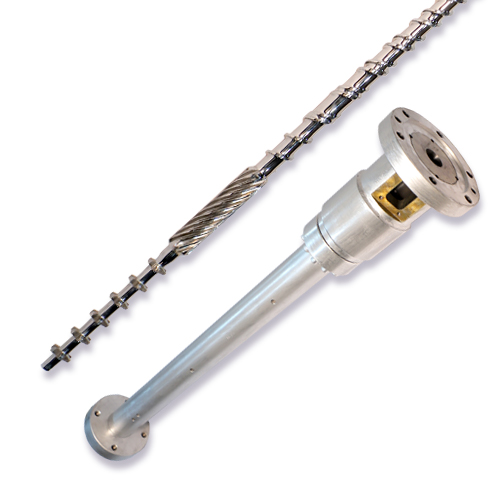
Brochure for Single Screw Barrel
Brochure for Twin Screw Barrel
At Hi Tech Screw Barrel Works, every extruder screw barrel is engineered from verified raw material (38CrMoAl / DIN 1.8509 for nitrided grades; proprietary HF alloy bimetallic liner for corrosive-service grades) and manufactured on CNC grinding centres maintaining bore roundness below 0.015 mm and surface roughness Ra ≤ 0.4 µm. The result is an assembly that delivers measurable production advantages: stable die-head pressure, elimination of surging, reduced colour-change downtime, and a documented service life of 4–9 years in demanding applications.
Hi Tech supplies extruder screw barrels to processors handling standard polyolefins (HDPE, PP, LLDPE), corrosive polymers (PVC, CPVC, RPVC), engineering grades (ABS, PA, PBT, PC), glass- and mineral-filled compounds, and recycled regrind — across pipe, film, cable, compounding, blown film, sheet, and recycling lines.
Price of Extruder Screw Barrel
|
Screw Minimum Size (mm or inch) |
Screw Maximum Size (mm or inch) |
Barrel Minimum Size (mm or inch) |
Barrel Maximum Size (mm or inch) |
Minimum Price (In Rs) |
Maximum Price (In Rs) |
|---|---|---|---|---|---|
|
18mm |
300mm |
18mm |
300mm |
Rs. 35,000 |
Rs. 40,00,000 |
Benefits
Improved Material Handling and Mixing
Extrusion machinery screw barrels ensure efficient material handling, melting, and mixing of additives, colorants, and fillers into the polymer melt. This results in uniform melt quality and enhanced product properties.
Enhanced Durability and Wear Resistance
Our screw barrels are manufactured from high-grade materials such as nitrided steel, bimetallic alloys, and tungsten carbide coatings, offering exceptional wear resistance and durability. This extends service life and reduces maintenance costs.
Optimized Processing Parameters
By optimizing screw design and material selection, our screw barrels improve extrusion parameters such as melt pressure control, die swell, and dimensional accuracy. This enhances production efficiency and reduces scrap rates.
Customization Options
We offer customization options to meet specific customer requirements, including screw diameter, length-to-diameter ratio (L/D), flight geometry, material composition, and surface coatings. Our engineering expertise ensures that each extrusion machinery screw barrel is tailored for maximum performance and reliability.
Key Product Features
Material Grade: 38CrMoAl (DIN 1.8509) & Proprietary HF Alloy
The extruder screw body is manufactured from 38CrMoAl alloy steel — the recognised global standard for nitrided plasticating screws — achieving a nitrided case depth of 0.4–0.6 mm at 900–1,100 HV surface hardness. Bimetallic barrels carry a centrifugally cast HF alloy (Boron-Nickel-Chromium-Tungsten matrix) bore liner of 1.5–3.0 mm thickness, hardened to 950–1,100 HV, providing corrosion and abrasion resistance unmatched by standard nitrided alternatives.
Dimensional Accuracy: ±0.01 mm Machined Tolerance
All extruder screw barrels are finish-ground and honed to ±0.01 mm diameter tolerance. Bore roundness is held below 0.015 mm; concentricity of screw OD to shank axis is maintained within 0.01 mm. These tolerances ensure correct screw-to-barrel clearance (0.05–0.15 mm range by diameter), eliminating excess melt back-flow that degrades output volumetric efficiency.
Surface Finish: Ra ≤ 0.4 µm (Bore) | Ra ≤ 0.2 µm (Flight OD — Premium Grade)
Post-honing bore surface roughness of Ra ≤ 0.4 µm minimises polymer adhesion, reduces colour-change residence time, and prevents degraded material from accumulating in surface irregularities. Premium bimetallic grades achieve Ra ≤ 0.2 µm on the screw flight OD for applications demanding the highest melt purity — medical tubing, food-grade film, optical-grade sheet.
L/D Ratio Range: 20:1 to 36:1 — Custom Configured
Hi Tech manufactures extruder screw barrels across the full industry L/D range. Standard configurable ratios: 20:1, 22:1, 24:1, 26:1, 28:1, 30:1, 32:1, 36:1. L/D selection is matched to polymer type, required melt homogeneity, and target throughput — not offered as a one-size catalogue listing.
Full Range of Screw Geometries
Available geometries include single-flight standard, barrier screw (secondary barrier flight for separation of solid bed and melt pool), vented two-stage (with vent port for degassing), groove feed (grooved barrel feed zone for enhanced solid intake), and conical twin (wider feed, narrower metering end for rigid PVC lines). Each geometry is engineered to the polymer’s specific processing requirements.
Bimetallic & HVOF Surface Treatment Options
Three surface treatment tiers are available: (a) Gas/ion nitrided — 900–1,100 HV, 0.4–0.6 mm depth, for standard polyolefins; (b) Bimetallic HF alloy centrifugally cast — 950–1,100 HV, 1.5–3.0 mm, for PVC, CPVC, glass-filled, and corrosive applications; (c) HVOF thermal spray coating — 1,100–1,200 HV, extreme wear resistance for highly abrasive glass-fibre and mineral-filled compounds above 30% loading.
Full Traceability — MTC, Hardness Reports, Dimensional Inspection Records
Every extruder screw barrel is shipped with a Material Test Certificate (MTC) confirming steel grade and heat number, a hardness test report (HV values at 3 axial positions), and a dimensional inspection report covering bore ID, screw OD, concentricity, and surface finish. These documents support customer quality management systems and OEM warranty compliance requirements.
OEM Reverse Engineering & Custom Manufacture
Hi Tech manufactures extruder screw barrels as direct replacements for all major machine brands — Davis-Standard, Battenfeld, Krauss-Maffei, Cincinnati, Rajoo Engineers, Windsor, Kabra, Lohia, and all Indian OEM makes. Replacements are produced from OEM drawings or from physical component measurement. Custom geometries and novel screw designs are accepted on enquiry.
Technical Specifications
| Parameter | Standard Range | Custom / Extended Range | Unit / Note |
|---|---|---|---|
|
Screw Diameter |
25 – 200 mm |
200 – 400 mm (on enquiry) |
mm nominal |
|
L/D Ratio |
20:1 to 30:1 |
32:1 to 36:1 |
Standard configurable |
|
Compression Ratio |
1.8:1 to 3.2:1 |
3.5:1 to 4.5:1 |
Feed/metering depth ratio |
|
Flight Pitch (standard) |
1.0 × D (square pitch) |
Variable/multi-start |
mm per revolution |
|
Nitrided Case Depth |
0.4 – 0.6 mm |
Up to 0.8 mm |
Per DIN 58761-1 |
|
Surface Hardness (Nitrided) |
900 – 1,100 HV |
– |
Vickers HV10 |
|
Bimetallic Liner Thickness |
1.5 – 2.0 mm |
2.5 – 3.0 mm |
Centrifugally cast HF alloy |
|
Bore Hardness (Bimetallic) |
950 – 1,100 HV |
– |
Vickers HV10 |
|
Screw OD Tolerance |
±0.01 mm |
±0.008 mm (premium) |
CNC ground |
|
Bore Roundness |
< 0.015 mm |
< 0.010 mm (premium) |
Honed finish |
|
Surface Roughness — Bore (Ra) |
≤ 0.4 µm |
≤ 0.2 µm (premium) |
ISO 4287 |
|
Screw-to-Barrel Clearance |
0.05 – 0.10 mm (< 80 mm Ø) |
0.08 – 0.15 mm (> 80 mm Ø) |
Per Ø class |
|
Screw Core Material |
38CrMoAl (DIN 1.8509) |
4140 / H13 / D2 on spec |
Mill-certified steel |
|
Barrel Shell Material |
38CrMoAl / 42CrMo4 |
Alloy steel per OEM spec |
Mill-certified |
|
Operating Temperature (max) |
Up to 450°C |
– |
Barrel wall — continuous |
|
Screw Flight Root Radius |
Minimum 0.5 × D pitch / 10 |
Custom per torque calculation |
Fatigue-resistant design |
|
Heat Treatment |
Gas nitriding / Ion nitriding |
Bimetallic centrifugal cast / HVOF |
In-house + outsourced HVOF |
|
Quality Documents Supplied |
MTC + Hardness Report + DI Report |
PPAP documentation on request |
Included standard |
Extruder Screw Barrel Types — Full Product Range
| Type | Configuration | Primary Application | Surface Treatment |
|---|---|---|---|
|
Single Screw Barrel |
One screw, single-bore barrel |
Pipe, film, sheet, cable, blow moulding, injection |
Nitrided or Bimetallic |
|
Twin Parallel Screw Barrel |
Two co-/counter-rotating screws, figure-8 bore |
PVC compounding, masterbatch, engineering plastics |
Bimetallic (standard for PVC) |
|
Twin Conical Screw Barrel |
Conical geometry, wider feed end |
Rigid PVC profile, PVC pipe direct extrusion |
Bimetallic |
|
Vented (Two-Stage) Screw Barrel |
Decompression + vent zone + second compression |
PET sheet, PA, hygroscopic resins — in-line drying |
Nitrided or Bimetallic |
|
Barrier Screw Barrel |
Secondary barrier flight, separated melt/solid zones |
High-output HDPE, PP, LLDPE blown film lines |
Nitrided or Bimetallic |
|
Groove Feed Screw Barrel |
Grooved feed section in barrel ID |
High-viscosity HDPE, PP, rigid PVC, UHMW-PE |
Bimetallic (barrel zone) |
|
Bimetallic Screw Barrel |
HF alloy bore, alloy steel shell |
PVC, CPVC, glass-filled, abrasive compounding |
Centrifugally cast HF alloy |
|
Customised Screw Barrel |
Any geometry per OEM drawing or sample |
Speciality polymers, non-standard machines |
Per specification |
How an Extruder Screw Barrel Works — 4-Stage Plasticating Mechanism
Stage 1 — Solid Conveying (Feed Zone)
Polymer granules or powder enter the barrel from the hopper and are received by the deep-channelled feed zone of the extruder screw. The rotating screw flights mechanically drag the solid bed forward through frictional forces between the granules, the barrel wall, and the screw surface. The grooved-feed barrel variant enhances this frictional intake — critical for high-viscosity HDPE, UHMW-PE, and rigid PVC — by increasing surface friction in the feed zone through precision-machined axial grooves in the barrel bore. Barrel heating zones begin pre-warming the outer solid bed layers.
Stage 2 — Melting & Compression (Transition/Compression Zone)
The channel depth of the extruder screw progressively decreases from feed to metering end. As the solid bed is compressed against the heated barrel wall, a thin melt film forms at the barrel interface. Viscous shear between the rotating screw and this melt film generates the dominant heat source — viscous dissipation — which, combined with conducted heat from the barrel heater bands, propagates melting from the barrel wall inward through the solid bed. Compression ratio (typically 2:1 to 4.5:1 depending on polymer) determines the rate of channel depth reduction and the resulting shear rate and melt temperature.
Stage 3 — Melt Homogenisation (Metering Zone)
The metering zone carries constant shallow channel depth, delivering a fully molten polymer stream at stable pressure. The primary function here is pressure generation and melt homogenisation — ensuring uniform temperature distribution (±5°C variation target), consistent melt density, and elimination of unmixed pockets. Barrier screw designs physically separate the solid bed from the melt pool using a secondary flight, preventing unmelted particles from entering the metering zone and improving melt quality by 15–25% in high-output applications.
Stage 4 — Degassing / Vent Zone (Vented Screw Barrels Only)
Two-stage vented screw barrels include a decompression zone upstream of the vent port, where melt pressure drops below atmospheric pressure. Volatile compounds — moisture, residual monomers, solvents — are released through the vent opening in the barrel wall. A second compression stage then re-pressurises the melt for delivery to the die. This eliminates the need for pre-drying hygroscopic resins (PET, PA, PC) in many applications, reducing energy consumption and cycle time. The vent port and barrel zone around it are designed for easy cleaning and inspection.
Applications — Industry-Wise Coverage
| Industry / Process | Polymer | Machine Type | Recommended Variant |
|---|---|---|---|
|
PVC Pressure Pipe & Fittings |
UPVC, RPVC, CPVC |
Single screw extruder |
Bimetallic single screw barrel |
|
HDPE Water & Gas Pipe |
HDPE PE80/PE100 |
Single screw extruder |
Nitrided or bimetallic single screw barrel |
|
Blown Film — Packaging |
HDPE, LLDPE, LDPE |
Single screw film extruder |
Barrier screw barrel; nitrided |
|
PP Raffia / Tape Plant |
PP homopolymer |
High-speed tape extruder |
28:1+ L/D nitrided; groove feed option |
|
Cable & Wire Insulation |
PVC, XLPE, HDPE |
Cable extruder (45–150 mm) |
Bimetallic (PVC); HVOF (XLPE-abrasive) |
|
Sheet & Thermoforming |
PP, HIPS, PET |
Sheet extruder |
Vented (PET); standard nitrided (PP/HIPS) |
|
Masterbatch & Compounding |
PA, PBT, PC + glass fibre |
Twin screw extruder |
Bimetallic twin screw; HVOF > 30% GF |
|
Rubber Hose & Seals |
EPDM, NBR, SBR |
Rubber extruder |
Low-CR single screw; nitrided |
|
Plastic Recycling / Pelletising |
Mixed polyolefins, regrind |
Single or twin screw |
Bimetallic — contamination-resistant |
|
Blown Film — Multi-Layer |
LLDPE/HDPE/barrier |
Co-extrusion multi-screw line |
Individually configured per layer polymer |
|
Food Machinery |
Food-grade PP, LDPE |
Food extruder |
Chrome or stainless-compatible; nitrided |
|
Air Bubble / PP Sheet Plant |
LDPE, PP |
Sheet/film extruder |
Standard nitrided; barrier option for PP |
Surface Treatment Options — Selection Guide
| Treatment | Hardness (HV) | Layer Depth | Wear Resist. | Corrosion Resist. | Best Application |
|---|---|---|---|---|---|
|
Gas Nitriding |
900–1,050 HV |
0.4–0.6 mm |
High |
Medium |
HDPE, PP, LLDPE, PS, ABS |
|
Ion (Plasma) Nitriding |
1,000–1,100 HV |
0.4–0.6 mm |
Very High |
Medium |
High-precision screws — tight tol. |
|
Bimetallic HF Alloy |
950–1,100 HV |
1.5–3.0 mm |
Very High |
High |
PVC, CPVC, glass-filled, abrasive |
|
HVOF Thermal Spray |
1,100–1,200 HV |
0.3–0.8 mm |
Extremely High |
Very High |
> 30% GF, high-abrasive compounds |
|
Hard Chrome Plating |
800–950 HV |
0.05–0.2 mm |
Medium |
High |
Standard use, budget replacement |
|
Tool Steel (D2/H13) |
700–850 HV (through) |
Through-hardened |
Medium-High |
Low-Medium |
General-purpose; non-corrosive resin |
Why Choose Hi Tech Screw Barrel Works
Manufacturing Infrastructure — CNC Precision at Scale
Hi Tech Screw Barrel Works operates a dedicated manufacturing facility in Ahmedabad, Gujarat, equipped with CNC turning centres, internal CNC grinding machines, deep-hole boring machines, honing machines, and controlled atmosphere nitriding furnaces. This end-to-end in-house capability — from raw material receipt to final dimensional inspection — ensures complete production control without sub-contracting at any critical machining stage.
Complete Product Range — One Supplier for All Screw Barrel Needs
Hi Tech manufactures the full spectrum: single screw barrel, twin screw barrel (parallel and conical), barrier screw barrel, vented screw barrel, bimetallic screw barrel, groove feed screw barrel, and fully customised assemblies. Processors with multi-line facilities across different polymer types source their complete requirement from a single, accountable manufacturer — simplifying procurement, warranty management, and technical support.
Custom Engineering — OEM Match & Reverse Engineering
Every extruder screw barrel is engineered to customer specification. Hi Tech accepts OEM engineering drawings (any format), physical component samples for reverse engineering, or application data (polymer, throughput, machine make, L/D requirement) for a specification recommendation. Dimensional matching to OEM tolerances is guaranteed, eliminating fitment issues that commonly arise with generic catalogue replacement parts.
Quality Assurance — Full Documentation with Every Unit
No extruder screw barrel leaves Hi Tech without a Material Test Certificate (steel grade and heat number), a hardness test report (minimum 3 axial measurement positions per component), and a dimensional inspection report. Customers receive complete traceability documentation as standard — not on request. This supports ISO 9001-compliant quality management systems at customer facilities and satisfies OEM warranty requirements.
Application Expertise — Deep Domain Knowledge Across All Sectors
With over a decade of manufacturing experience and installed extruder screw barrels operating across pipe, film, cable, compounding, sheet, rubber, recycling, and food processing sectors throughout India and in export markets, Hi Tech’s engineering team provides application-specific recommendations based on real field data. This is not catalogue sales — it is consultative technical support delivered by engineers who understand polymer processing demands.
Comparative Analysis — Nitrided vs. Bimetallic vs. Hi Tech Premium Grade
The most consequential procurement decision for any plastic processor is selecting the correct surface treatment. The table below provides a direct grade-level comparison to guide specification:
| Parameter | Standard Grade (Nitrided) | Premium Grade (Bimetallic) | Hi Tech Premium (Bimetallic + HVOF Option) |
|---|---|---|---|
|
Base Material |
EN8 / 1045 or 38CrMoAl |
38CrMoAl (DIN 1.8509) |
38CrMoAl + proprietary HF alloy liner |
|
Surface Hardness (HV) |
750–900 HV |
900–1,050 HV |
950–1,100 HV (bimetallic) / 1,100–1,200 HV (HVOF) |
|
Wear-Resistant Layer Depth |
0.3–0.4 mm |
0.4–0.6 mm nitriding |
1.5–3.0 mm (bimetallic) |
|
Surface Finish — Bore (Ra) |
0.8–1.2 µm |
0.4–0.8 µm |
≤ 0.4 µm standard | ≤ 0.2 µm premium |
|
Bore Roundness |
0.025–0.05 mm |
0.015–0.025 mm |
< 0.015 mm (standard) / < 0.010 mm (premium) |
|
Corrosion Resistance (HCl) |
Low — not suitable for PVC |
Medium — limited HCl resistance |
High — HF alloy rated for chlorinated polymers |
|
Expected Service Life |
1.5–3 years (std polymers) |
3–5 years (std polymers) |
4–9 years depending on application |
|
Reconditioning Option |
Re-nitriding at ~35% of new cost |
Re-lining at ~40% of new cost |
Re-lining available — assessed per wear state |
|
Best For |
Budget replacement, HDPE/PP/PS |
Standard industry HDPE, PP, ABS |
PVC, CPVC, glass-filled, continuous-duty lines |
|
Quality Documents |
Variable by supplier |
MTC + hardness report |
MTC + hardness report + dimensional inspection |
The decisive differentiator between standard and premium grades is the thickness of the wear-resistant layer. Nitrided barrels can be re-ground only within the 0.4–0.6 mm nitrided depth — after which the barrel is effectively end-of-life. Bimetallic barrels carry 1.5–3.0 mm of wear-resistant alloy, providing a substantially greater wear reserve and a correspondingly longer economic life. For processors running PVC, CPVC, or any glass- or mineral-filled polymer, the premium lifecycle cost of bimetallic is lower than the accelerated replacement cycle and production losses from standard nitrided alternatives.
Buyer's Selection Guide — How to Specify the Correct Extruder Screw Barrel
Select by Polymer Type & Processing Condition
Standard polyolefins (HDPE, PP, LLDPE, LDPE, PS, ABS) at normal filler levels: Nitrided 38CrMoAl is appropriate. Gas-nitrided achieves the required 900–1,050 HV hardness with a 0.4–0.6 mm depth adequate for service lives of 3–5 years in continuous production.
Chlorinated polymers (PVC, CPVC, RPVC, PVDC): Always specify bimetallic screw barrel. PVC releases hydrochloric acid (HCl) during processing. HCl attacks nitrided steel within 6–18 months — accelerating bore enlargement, flash increase, and output loss. Only HF alloy bimetallic liners provide adequate chemical resistance.
Glass-fibre or mineral-filled compounds (loading > 10%): Specify bimetallic barrel AND bimetallic or HVOF-coated screw. Abrasive wear from glass or mineral fillers degrades standard nitrided surfaces rapidly. At > 30% GF loading, HVOF coating on the screw flight OD and bimetallic barrel is the minimum-acceptable specification.
Engineering plastics (PA, PBT, PC, POM) at standard filler levels: Nitrided or bimetallic depending on filler. Unfilled grades can use nitrided; glass-filled grades require bimetallic as above.
Select by L/D Ratio
L/D selection determines dwell time, mixing quality, and achievable throughput. Use the following thresholds as a starting specification — confirm with Hi Tech’s technical team for your specific polymer, MFI, and output target:
• 20:1 to 22:1 — Simple HDPE/PP, low-viscosity PE pipe, standard blown film at moderate output
• 24:1 to 26:1 — HDPE film, general single-screw extrusion, most blown film applications
• 28:1 to 30:1 — PVC profile, ABS, engineering plastics, higher-output pipe lines
• 32:1 to 36:1 — Compounding, masterbatch, vented degassing, PET in-line drying, high-fill compounds
Select by Dimensional Compatibility
Provide Hi Tech with one of the following: (a) OEM engineering drawing with gearbox coupling dimensions, barrel flange bolt pattern, and feed throat dimensions; (b) physical worn component for reverse-engineering measurement; or (c) machine make, model, and serial number for cross-reference. All dimensional data is treated as confidential and used solely for manufacturing.
Select by Certification Requirement
Standard supply includes Material Test Certificate (MTC) and hardness report as baseline quality documents. Food-grade applications require chrome or stainless-compatible surface finish and certification of food-safe material compliance. Export or OEM-supply applications requiring PPAP documentation, third-party inspection, or specific test report formats are accommodated on project enquiry.
Select by Supply Mode (OEM / MRO / Custom)
Three supply modes are available: (1) Catalogue replacement — standard diameters and L/D ratios from production stock, typically dispatched within 5–10 working days; (2) OEM-matched replacement — manufactured to drawing or reverse-engineered measurement, lead time 3–6 weeks by diameter; (3) Custom-engineered — novel screw geometry, non-standard materials, or prototype development, lead time by project scope. Contact Hi Tech’s technical team with your specification to confirm the correct supply mode and lead time.
Application Scenarios & Field Use Cases
Scenario 1 — Rigid PVC Pressure Pipe Extrusion (CPVC Hot-Water Line)
Setting: Single-screw extruder, 90 mm diameter, running CPVC compound for hot-water pressure pipe production. Operating temperature: 185–200°C. Continuous production duty.
Challenge: CPVC releases HCl at processing temperatures, causing severe corrosive attack on the barrel bore. A previously installed standard nitrided barrel showed 0.4 mm bore enlargement within 14 months, causing flash increase, output loss of approximately 12%, and unplanned replacement downtime.
Solution: Hi Tech supplied a bimetallic single screw barrel with centrifugally cast HF alloy bore (2.0 mm liner thickness, 1,000 HV), matched to the OEM barrel flange and gearbox coupling dimensions. Screw flights were coated with HVOF spray on the OD.
Outcome: Documented service life extension to 52 months at re-inspection — bore enlargement of 0.12 mm over that period. Output consistency maintained within ±3% of target throughout. [To confirm final bore measurement data from customer site].
Scenario 2 — High-Output HDPE Blown Film Line
Setting: 60 mm barrier screw extruder, 28:1 L/D, running HDPE film grade (MFI 0.05–0.3 g/10 min) at high output. Operating at approximately 230–250°C melt temperature.
Challenge: Standard single-flight screw was delivering gel particles and fish-eye defects in the finished film — attributed to unmelted polymer fragments passing through the metering zone. Output rate was being limited by surging at the die head.
Solution: Hi Tech supplied a barrier screw barrel: secondary barrier flight configured to maintain solid-melt separation, with optimised barrier flight clearance of 0.15 mm to the barrel bore. Bore surface Ra achieved ≤ 0.4 µm.
Outcome: Gel particle frequency reduced to below detectable threshold in downstream optical inspection. Output rate improved by 18% at equivalent screw speed without melt temperature increase. Surging eliminated. [Throughput improvement data — to confirm with customer].
Scenario 3 — Glass-Filled PA66 Compounding Line
Setting: Co-rotating twin screw extruder, 50 mm screw diameter, 40:1 L/D, compounding PA66 + 30% glass fibre for automotive component production.
Challenge: At 30% glass fibre loading, abrasive wear on standard nitrided twin screw elements and barrel liner was accelerating rapidly. Dimensional checks at 8 months showed bore enlargement of 0.35 mm — well beyond the 0.15 mm tolerance threshold — leading to output degradation and specification non-conformance in compounded granule quality.
Solution: Hi Tech supplied bimetallic twin screw elements (HF alloy OD, 2.5 mm liner) with matching bimetallic barrel sections. Screw element OD tolerance maintained at ±0.01 mm across all segments.
Outcome: At 18-month inspection, bore enlargement was 0.08 mm — within acceptable operational range. Estimated remaining service life at inspection: 24+ additional months. [Confirm dimensional records from maintenance log].
Scenario 4 — PP Raffia Tape Plant (High-Speed Production)
Setting: 120 mm single screw extruder, 28:1 L/D, running PP homopolymer (MFI 3–8 g/10 min) for raffia tape production. Operating at 230–260°C at maximum RPM for output optimisation.
Challenge: High screw speed combined with the relatively low melt viscosity of PP homopolymer at elevated temperature was generating excess melt temperature variation (±18°C at die head), causing tape thickness inconsistency and downstream drawing failures.
Solution: Hi Tech supplied a groove feed screw barrel: 80 mm grooved feed section (6 grooves, 3 mm depth) in the barrel bore to increase solid intake friction at the feed zone, enabling stable output at lower screw speed. Screw geometry adjusted to lower compression ratio (2.8:1) to reduce shear heating.
Outcome: Melt temperature variation reduced to ±6°C at die head at target output rate. Tape thickness consistency improved, reducing downstream drawing breaks by estimated 60%. Screw speed reduced by 15% to achieve the same output — extending mechanical life of drive system. [Confirm yield improvement data with customer].
Frequently Asked Questions — Extruder Screw Barrel
What is an extruder screw barrel and how is it different from an injection moulding screw barrel?
An extruder screw barrel is a continuous-output plasticating assembly — the screw rotates constantly and the melt is continuously pushed forward to the die. An injection moulding screw barrel is a reciprocating assembly: the screw first rotates to plasticate and accumulate a shot, then moves axially forward to inject the melt into the mould. Extruder screws typically have longer L/D ratios (24:1 to 36:1) for thorough continuous melting; injection moulding screws are shorter (16:1 to 24:1) and designed for rapid shot accumulation. Both require precision screw-to-barrel clearance, but the wear mechanisms differ — extrusion sees continuous abrasive wear; injection sees both abrasive wear and impact shock at injection.
What is the correct screw-to-barrel clearance, and what happens when it exceeds tolerance?
Standard screw-to-barrel clearance is 0.05–0.10 mm for screw diameters below 80 mm, and 0.08–0.15 mm for diameters above 80 mm. As the clearance increases beyond 0.2–0.3 mm through wear, melt leakage flow (back-flow) increases — reducing net output volumetric efficiency by 5–15% per additional 0.1 mm of clearance. Beyond 0.5 mm clearance increase, the output drop is typically 15–25%, and melt temperature rises due to increased shear in the enlarged gap. Annual bore and screw diameter measurement using a calibrated bore gauge and digital micrometer is the recommended minimum predictive maintenance practice.
How do I calculate the correct L/D ratio for my extrusion application?
Start with the polymer category: standard polyolefins (HDPE, PP) are well-plasticised at L/D 24:1 to 26:1. For PVC profile, ABS, and engineering plastics requiring better mixing, use 28:1 to 30:1. For compounding with glass fibre, masterbatch production, or degassing applications, use 32:1 to 36:1. Within these ranges, a longer L/D provides more residence time for mixing and melting but also increases specific energy input (kWh/kg). The formula for melt residence time is: t = (π × D² × L × n_z) ÷ (4 × Q), where D = screw diameter, L = screw length, n_z = metering zone channel depth, Q = volumetric throughput. For a specific calculation, share your polymer, output target (kg/hr), and motor specification with Hi Tech’s technical team.
Can a worn extruder screw barrel be reconditioned rather than replaced?
Yes — reconditioning is viable at the correct wear stage. For nitrided screws, hard chrome plating on the flight OD followed by re-grinding restores flight OD to original dimension. Re-nitriding restores bore surface on nitrided barrels. For bimetallic barrels, the HF alloy bore can be re-lined by centrifugal casting if the barrel shell retains structural integrity. Cost of reconditioning is typically 30–50% of new replacement cost. The economic decision point: if bore enlargement exceeds 0.5 mm, or flight OD has reduced by more than 0.8 mm, the additional machining required to restore geometry absorbs the cost saving — replacement is more economical. Hi Tech performs reconditioning assessments on component samples; send in your worn screw or barrel for a free dimensional report and reconditioning vs. replacement recommendation.
What is a bimetallic barrel and why is it mandatory for PVC processing?
A bimetallic barrel consists of an alloy steel outer shell with a centrifugally cast bore lining of HF (High-Iron) alloy — typically a Boron-Nickel-Chromium-Tungsten matrix — applied at 1.5–3.0 mm thickness. The HF alloy achieves 950–1,100 HV hardness with high corrosion resistance. PVC and CPVC release hydrochloric acid (HCl) at processing temperatures (160–210°C). HCl attacks standard nitrided steel at pH < 2, causing surface pitting, bore enlargement, and accelerated wear that cannot be economically repaired. The HF alloy matrix in a bimetallic barrel is resistant to HCl attack — maintaining bore integrity for 4–9 years of typical PVC service life, compared to 1–2 years for a nitrided barrel running the same compound.
What is the difference between gas nitriding and ion (plasma) nitriding for extruder screw barrels?
Both processes diffuse nitrogen into the surface of 38CrMoAl steel to form a hard compound layer (epsilon phase + gamma prime phase). Gas nitriding uses ammonia atmosphere at 480–530°C for 20–80 hours — well-established, lower equipment cost, batch process. Ion nitriding uses plasma discharge in nitrogen/hydrogen atmosphere — achieves a slightly harder, denser compound layer (1,000–1,100 HV vs. 900–1,050 HV for gas), with better control over white layer thickness and reduced distortion. For precision screws with tight tolerances or complex flight geometry, ion nitriding is preferred. For standard production volumes, gas nitriding delivers equivalent functional performance at lower cost. Hi Tech supplies both based on application requirement.
How should extruder screw barrels be purged and stored during machine shutdown?
For scheduled shutdown (planned maintenance): purge with a compatible purging compound (polyethylene-based purge for PE/PP lines; commercial PVC purge for PVC lines) until the extrudate runs clear and free of colour or contamination. Reduce barrel temperature to 80–100°C before stopping the screw. For long-term storage (machine idle > 4 weeks): purge completely, reduce to ambient temperature, and apply a thin film of food-grade corrosion-inhibiting grease to the screw OD before extraction if the screw is to be stored separately. Store screw horizontally on V-blocks or vertically in a support fixture — never laid flat unsupported or resting on flights, as this can cause permanent sag in larger diameters.
What quality documents should be requested when purchasing an extruder screw barrel?
At minimum, request: (1) Material Test Certificate (MTC) confirming steel grade (e.g. 38CrMoAl / DIN 1.8509), heat number, and chemical composition; (2) Hardness Test Report — surface hardness (HV) at minimum 3 axial positions; (3) Dimensional Inspection Report — screw OD, barrel bore ID, concentricity, and surface roughness Ra values. For premium or critical applications, additionally request: heat treatment log (temperature, atmosphere, time, and furnace ID for the nitriding cycle); bore photographic documentation; and a statement of traceability to raw material mill certificate. Hi Tech supplies items 1–3 as standard with every delivery; items 4–6 are available on specification at time of order.
What is the typical lead time for a custom extruder screw barrel from Hi Tech?
Standard catalogue sizes (50 mm to 120 mm diameter, nitrided single screw barrels in common L/D ratios): typically 5–10 working days from order confirmation. OEM-matched replacements manufactured from drawing: 3–6 weeks depending on diameter and surface treatment. Bimetallic barrels: 4–6 weeks (centrifugal casting process requires additional furnace scheduling). Large-diameter units (> 200 mm) or custom geometries: 6–10 weeks. For urgent breakdown replacement, contact Hi Tech directly — priority scheduling is available on a capacity-subject basis. Always maintain a record of your screw barrel dimensions (OEM drawing reference or measured data) to enable fastest possible re-order.
Where is Hi Tech Screw Barrel Works located, and which regions are served?
Hi Tech Screw Barrel Works is located at Hi-Tech Avenue, Plot No. 40, Panchamrut-3 Industrial Park, Village Dhamatvan, Tal. Daskroi, Ahmedabad – 382445, Gujarat, India. Ahmedabad is India’s foremost plastic processing manufacturing hub, providing direct access to the highest concentration of extrusion, injection moulding, blow moulding, and compounding processors in the country. Hi Tech supplies customers across Gujarat, Maharashtra, Rajasthan, Delhi-NCR, Tamil Nadu, Karnataka, and all other Indian states, with export deliveries to South Asia, Southeast Asia, Africa, and the Middle East. Domestic courier and freight dispatch is available for all orders; site visits by Hi Tech’s technical team are available for customers in Gujarat and surrounding regions.
What certifications does Hi Tech Screw Barrel Works hold?
Hi Tech Screw Barrel Works operates under a quality management system aligned with ISO 9001:2015 requirements. All product documentation — Material Test Certificates, hardness reports, and dimensional inspection records — provides full traceability to raw material origin. Customers requiring specific third-party inspection (SGS, Bureau Veritas, TUV, or other agencies) for export or OEM supply should specify this at time of enquiry. Certification documentation is regularly reviewed and updated; contact Hi Tech’s office for the current certificate status and issuing body details.
Technical Glossary — Extruder Screw Barrel Terminology
| Term | Definition |
|---|---|
|
L/D Ratio |
Length-to-Diameter ratio of the extruder screw. A 28:1 L/D on a 60 mm screw = 1,680 mm screw length. Higher L/D provides more residence time, better mixing, and improved melt homogeneity — but increases shear energy input. |
|
Compression Ratio (CR) |
Ratio of feed zone channel depth to metering zone channel depth. CR 3.0:1 means the feed channel is 3× deeper than the metering channel. Higher CR = more aggressive compression; used for high-crystallinity polymers (HDPE, PP). Low CR (1.8–2.2:1) for shear-sensitive PVC. |
|
HV (Vickers Hardness) |
Surface hardness measurement unit used for nitrided and bimetallic screw barrel surfaces. Measured by indentation under a defined load. A nitrided screw barrel reaches 900–1,100 HV; bimetallic HF alloy 950–1,100 HV. Higher HV = greater wear resistance. |
|
HRC (Rockwell C Hardness) |
Alternative hardness scale used for through-hardened tool steels. D2 tool steel typically 60–62 HRC; H13 hot-work steel 46–52 HRC. Used for screw body hardness where applicable. |
|
Ra (Surface Roughness Average) |
Arithmetic mean deviation of the surface profile from a mean line, measured in micrometres (µm). Extruder barrel bore: Ra ≤ 0.4 µm after honing. Lower Ra = smoother bore = less polymer adhesion = easier colour change, better melt purity. |
|
Bimetallic Liner |
A bore liner produced by centrifugal casting of molten HF (High-Iron) alloy — typically a Boron-Nickel-Chromium-Tungsten matrix — into a rotating alloy steel barrel shell. Produces 1.5–3.0 mm of wear-resistant, corrosion-resistant bore surface. Used for PVC, CPVC, glass-filled, and highly abrasive applications. |
|
38CrMoAl (DIN 1.8509) |
The standard alloy steel grade for nitrided plasticating screws and barrels. High chromium, molybdenum, and aluminium content provides excellent nitrogen affinity — enabling deep, hard nitrided case formation. Recognised under DIN, BS, and JIS standards. |
|
HVOF (High-Velocity Oxygen Fuel) |
Thermal spray process using combustion of fuel/oxygen at supersonic velocity to deposit tungsten carbide or chromium carbide particles onto the substrate surface. Produces coatings of 1,100–1,200 HV with porosity < 1% — superior to electroplated hard chrome for extremely abrasive applications. |
|
Flight Root Radius |
The curved transition between the screw flight and the core (root) of the screw. A generous root radius (≥ 0.5 × flight pitch / 10) distributes torsional stress and prevents fatigue cracking at the feed zone root — the highest-stress location on an extruder screw. |
|
Back-Pressure / Leakage Flow |
The reverse flow of melt from metering zone back toward the feed zone through the screw-to-barrel clearance gap, driven by the die-head pressure gradient. Increases as clearance enlarges with wear — reducing volumetric efficiency. A leading indicator of screw barrel wear requiring replacement. |
Maintenance Schedule — Maximising Extruder Screw Barrel Service Life
| Frequency | Action | Parameter / Limit |
|---|---|---|
|
Every Shutdown |
Purge with compatible purging compound until clear extrudate |
Visual clarity — no colour or contamination visible |
|
Weekly |
Check barrel heater zone temperatures for uniformity |
Zone-to-zone deviation ≤ ±5°C from set point |
|
Monthly |
Measure screw OD at 3 axial positions — feed, middle, metering |
Wear > 0.1 mm from original = flag for monitoring |
|
Quarterly |
Measure barrel bore ID at feed and metering zones |
Clearance increase > 0.2 mm = plan next replacement |
|
6-Monthly |
Measure die-head pressure stability across production run |
Pressure variation > ±5 bar = check clearance |
|
Annually |
Full screw pull-out inspection — visual + dimensional |
Flight surface, bore pitting, torsional deformation check |
|
At Each Shutdown (long-term idle) |
Apply corrosion-inhibiting grease to screw OD; store on V-blocks |
Prevents atmospheric corrosion during storage |
|
As Required |
Heater band and thermocouple calibration check |
Temperature accuracy to ±2°C; replace faulty elements |
Request a Custom Specification & Quote
Hi Tech Screw Barrel Works engineers extruder screw barrels to exact specification — for every polymer, every machine brand, and every production demand. To request a technical consultation and quotation, provide the following information:
• Screw diameter (mm) and machine make / model
• L/D ratio required (or current OEM L/D)
• Polymer type(s), filler loading, and processing temperature range
• Required surface treatment (or application description for Hi Tech to recommend)
• OEM drawing, sample component, or dimensional data (if available)
• Required quantity and expected dispatch timeline